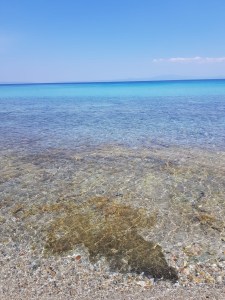
After the annual international dream conference of the IASD, held in the Netherlands this year, I visited Greece. Greece has been on my bucket list for over a decade. Finally, I made it! With only five days to spare, I stuck to the North East area of the country, exploring the city of Thessaloniki and Halkidiki peninsula. Time in the sea was, of course, a must. I also wanted to see with my own eyes evidence of a long lost dream culture.
 I spent time speaking with young Greeks, and even a few older ones. As I walked through downtown Thessaloniki, not for from Aristotle Square by the sea, I walk past 4th century monuments and wait…what?… yes, vendors selling Native American dreamcatchers. What a surprise! Young, contemporary Greeks call these oneiropagida yet they do not have a similar object from their own, forgotten, ancient dream-focused culture. Evidence for this lost culture is mostly found in museums nowadays, especially within the boundaries of my recent trip. One man, who is in his 20s, shared two opposing views of today’s Greek people. Dreams either mean little-to-nothing, he told me, or dreams must be interpreted, as they hold significance for some. For the latter group, oneirokritis or dream dictionaries, however, are popular. He considered those who use dream interpretation to be “superstitious,” yet as we spoke further, I understood that this term was not necessarily negative. The 21 year-old woman who was selling dreamcatchers, among other objects and souveniers, told me that for her and her friends, dreams were not meaningful. She said that her mother, however, carries a belief that night dreams are worth paying attention to and may lead to an action if they seemed meaningful. This isn’t a daily practice though, as some dreams hold more weight than other dreams.
A middle-aged cab driver from a small mountain town told me that contemporary Greeks today look at the old God/Goddess culture as “fairytales.” That old mythology is not a part of our contemporary belief system whatsoever, he conveyed. With regard to dreams, he said that this is also mostly ignored, yet for some Greeks, “powerful dreams” are given more attention. Those vivid, or easily recalled, types of dreams may need interpretation. The dream may be placed in one of two categories: good or bad. Dreams are judged, polarized, it seems. An example of a good dream may involve flying, he said, while a dream of a snake may be viewed as bad. I commented on how serpents were held in high regard, in the past, for their healing and transformative qualities. He agreed, but said “times have changed.” He attributed this shift in perspective to religious changes, particularly the rise of Christianity.
Thessaloniki’s archeological museum staff provided stimulating discussion regarding the Greek history of dreaming. Two women working in the museum shop shared some  information about the healing nature of snakes as we looked at a marble relief being sold there, which features Asclepius. A fourth century BCE relief depicts three stages of healing of a patient by the god Asclepius with two apotropaic eyes above. The healing ritual shown here appears to depict Asclepius giving injections and using snake venom as a healing substance. Some believe that Asclepius could transform into a healing serpent himself. The original can be found in the sanctuary of Amphiaraos at Oropos (Attica). Apotropaic magic refers to the power to avert evil or harmful influences, bad luck, misfortune, or the evil eye. Its popularity is evident, even today, by the vast number of apotropaic amulets sold worldwide. Other copies of votive offerings to Asclepius also feature the serpent. Snakes can be found in numerous pieces
  of jewelry (bracelets and earrings in particular) worn by the ancient Greek/Macedonian peoples. We discussed how the serpent, or snake, was considered a strong healing, transformative force historically, yet with the arrival of Christianity, this all changed. From then on, snakes were primarily associated with women and evil, or the devil, thus connecting the two. This myth continues to hold strong today. Then, she asked for me to help her understand a puzzling dream of her own. I say that I’m honored to listen, but cannot interpret another’s dream, as I am not the author of it. She agrees that dreams belong to the dreamer, and continues. We play the game, “If it were my dream,” and have an enlightening discussion. She smiles as her eyes widen,
  expressing thanks for my view on this dream, as if it were my own, revealing a positive resolution in the end. Dreams belong to the dreamer, yes, and isn’t it wonderful to have those that will listen and take them seriously. For these exchanges offer fresh insights and perspectives. I was delighted over my time spent in the museum and with it’s employees – they had much to say about Asclepius and healing, while the others I spoke with knew little, or nothing at all of that part of local ancient history.
My time in Greece will continue…hopefully within a year or two. Athens and the oracles and sanctuaries of the area are at the top of my list. Have you traveled to the ancient Greek regions where healing and dreaming were once so common? If so, tell us about it. Comments and discussion here are always welcome.
Happy Summer,
Kim
 IASD conferences hold a special place in my heart, not only for the cutting-edge workshops and research presentations (such as Dr. Krippner’s shown here), but also for the soulful attendees as well. To spend 5 days with a large group of professionals, who hold such love for dreams and dreaming, is precious indeed. The interdisciplinary inclusion really makes these events special. Discussing dream research and holding space for dreamwork processes with so many psychologists, anthropologists, students, physicians, authors, psychiatrists, artists, psychotherapists and other healers is a true learning experience. It was
  also exciting to deliver a workshop and share my recently published book, Extraordinary Dreams, with people from all over the world – those I only get to see once a year. And while I have been attending IASD conferences since 2012, this year I became a Board member. There will be much to learn in this new position.
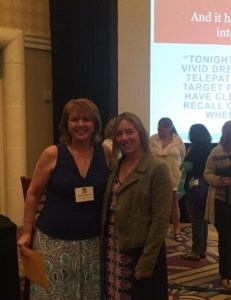 a dream telepathy contest modeled off of New York’s Maimonides Medical Center telepathy experiments from decades ago under Dr. Ullman and Dr. Krippner (here I am with Maureen, “the sender” for this years contest), a dream art exhibition featuring fine art in various media from artists worldwide, and on the final evening, a dream ball where attendees dress in a costume from a dream and are invited to share the dream if desired. If you missed us this year, you can find us –and the fun- next year. IASD’s 2019 conference will be held in Kerkrade, Netherlands. For more information, go to
  I was amazed by his craftsmanship, and the time he dedicated to making one-of-a-kind handmade books and journals. I thought, “Now this is a real dream journal – one to hold my most meaningful lucid dreams.” Here is Al in the construction process.
 recreate the metal body suit, which I did by knitting with some thin wire. Not easy! Later, I represented the image in a painting (shown here). This is just the beginning of re-establishing my relationship with armor – a concept I had set aside, for the most part, since graduate school.
 Unfortunately, I could not hold on to the exact ones, but I’m certain that they were all body parts. There were at least four, but likely many more. I brought the image to my dream group and processed its many possible meanings. Still, the image stuck with me and I began to draw it, then paint it (I now have plans to construct it in the near future). Through the artistic process my relationship to the meaning behind the raw imagery developed. This style of dreamwork can evolve over a long period of time leading to greater insight and awareness of one’s soul journey. So much of this space remains private, but I am beginning to reveal more and more in time. This image, in its many forms will be on public display in two art exhibitions this spring and summer. I’m excited to share more of my inner work with others and discuss how sleep related states have created meaning in the lives of my community.
 Conscious Chimera