As we are all currently living through these uncertain times, the desire to know what lies ahead and what we can do for our future runs high. These days, with the heightened anxiety and strong waves of emotion and fear, it is diffcult to determine if we will out come out of this  alright. What’s in your toolbox? We rely on our inner strength when separated from our communities. Mindfulness, prayer, and phone calls to loved ones help the days pass. I am certain that those who practice the art of divination are using all they know to navigate the oncoming terrain. If you have no experience in this area, why not start learning now?
Divination is “the art of discovering the future right now in the present,” it is the art of prophecy and the foretelling of the unknown, explains Judika Illes in her writings. The art of divination is passive in that it is not done to effect or cause change, but rather, it is a conscious attempt to obtain information regarding events. For many practitioners, she says, this art is sacred and spiritual.
This behavior, of divining, is nothing new. Divination has taken place for thousands of years, indeed it is an ancient practice that that grown and evolved over time. Long ago, diviners were consulted before the biggest decisions were made, such as those regarding war or sacrifice. There was great pressure to make accurate predictions, as you can imagine.
Just a few centuries ago in Britain, cunning folk (wise men/women) used methods of divination to restore or locate lost goods, whether stolen or misplaced. Sometimes divination was used to find a missing person. Other times it was used to make predictions, thus providing advice, on all sorts of matters. Wise men and women were also called upon to discover whether or not one’s illness or misfortune developed from malevolent witchcraft. As you can see from these examples alone, there are many reasons why one would want to develop this art, as it has served humanity for ages.
There many tools at the hand of a diviner – numerous methods and techniques are available for divination. Tarot, Runes, I-Ching and even palm reading rank at the top of the list concerning popularity. Below, I’ll describe some of my favorites or at least those that I find to be the most interesting.
- Automatic Writing or Psychography is written communication with a spirit done unconsciously by a person in a trance or semi-conscious state, according to paranormal-encyclopedia.com, however, I tend to think of the writing that emerges as coming from ones consciousness or higher power. A piece of ‘automatic writing’ can bloom out of a simple guided imagery or even a light state of self-hypnosis. I’ve experienced this through different class/workshop leaders and have found that diverse facilitation styles work well.
- Cartomancy is divining from cards. Sometimes the tool is a deck of tarot cards,
 other times it is a standard deck of playing cards. The branch of cartomancy that is specific to the use of the tarot for divination is called taromancy. I’m a fan of the classic Rider-Waite-Smith deck. I’ve had mine since I was 18 years old, tried-and-true!
 - Gyromancy is divination in which one walking in or around a circle falls from dizziness and prognosticates from the place of the fall. To expand on this definition, paranormal-encyclopedia.com, explains gyromancy as a form of divination that takes place by walking or twirling around a circle marked with letters until dizzy and, using the letters at the point where the person falls or stumbles to spell out a prophecy. Now that’s fascinating!
- Necromancy is a form of divination that involves communicating with the deceased and can involve summoning of the spirits of the dead for purposes of magically revealing the future or influencing the course of events.
- Oneiromancy is divination by means of dreams, specifically through the interpretation of dreams. This is a favorite. It is a divination method that I have practiced for about 15 years. One can incubate a dream in order to assist with the process.
- Dreamers report receiving messages or learning new information from the dearly departed. I add this here because sometimes deceased loved ones pop up in dreams to express love or just to tell us that they are okay. This is different that necromancy, as defined above. You can read more on this in my book Extraordinary Dreams.
- Radiesthesia describes divination through the use of a pendulum or rod. There are several ways in which to divine via radiesthesia. It describes the sensitiveness held to enable a person with the aid of divining rod or pendulum to detect things (such as the presence of underground water, the nature of an illness, or the guilt of a suspected person).
- Scrying is sometimes called crystal gazing, but it is more accurately the term for divination by seeking a vision while gazing into a transparent, translucent, or reflective object. Crystal scrying, sometimes done with a crystal ball, is just one well known example. One can scry with a bowl of liquid (wine, water, ink), a mirror (or specifically a black mirror), in fire (including the embers or smoke) and even through another person’s eyes. My very first experience of scrying at the age of 19 was done through the eyes of another. This friend (and his eyes) were my first teacher into the art of scrying. Later, I came to prefer dark reflective surfaces because they have worked best in my experience. I take good care of my obsidian mirror.
- Tasseography or tasseomancy is divination is done through the reading of tea leaves, coffee grounds, or wine sediments. Know that there are different ways to do this. For example, first brew a loose leaf tea (without a strainer), then when it has cooled down drink the tea as you concentrate on the question. Next, drain out the remaining bit of liquid by turning the cup over completely. Some or all of the remaining leaves will spill out. What remains in the tea cup reveals the prediction.
Throughout history, the ancient art of divination, in so many of its forms, has been both outlawed and condemned during certain periods of time, while during other times it has been praised by those in power, and even expected to some degree. Today, divination seems to have made its way into the spotlight again. Although those of certain persuasions do not speak highly of it. In my opinion, it is a personal decision to access materials and techniques for divination. If you don’t like it, leave it be. If instead, it calls to you, try it out. During this current ‘shelter-in-place’ order, it just might be the right time to delve into this ancient art. Just remember to dedicate yourself and practice daily. There are many experienced diviners of all types that are open to teach, consult and counsel. What tools and techniques do you want to learn more about? Which might you already use?
May your future be bright,
Kim
 like thoughts and emotions. We can stay aware of the body easily, but only if we remember to do so” (p. 139). Are you still aware of your posture, in this moment?
 one way. What does the soap feel like on the skin? And the sensation of the water running over the skin? Is the water hot, warm, cool, or cold? Another way of practicing mindfulness is to ring a chime or bell, then stay completely focused on the sound until it is no longer detectable. After, notice all other sounds in the environment. A third example could be to smell some things in your environment and really stay with the scent. If your lunch is in front of you, that makes this easy. If not, look for flowers during a walk, or a bouquet at the office. From the two photos here, you probably have an idea of what I love to smell – haha! Seriously, if you are at all like me, you might even carry a sachet of dried flowers or an essential oil in your bag. This is one of the reasons why I make dream pillows (see my product page for an idea). A final example for this article would be to stay connected to your breath. Notice each inhalation and each exhalation. Are you
  taking long deep abdominal breaths, or are they shallow, in the chest? Just noticing and staying connected to the senses and the body are ways of entering a mindful state. I hope you are encouraged to bring mindfulness into your daily life.
 mind and the emotions. Taking in fresh air while surrounded by plants and trees is a gift in itself. We can connect spiritually in nature as well. After all, everything is alive. Some people I know go camping (sleeping on the ground directly) every season while others dedicate a weekend day to beach walks, forest trail running or engaging in the practice known as Earthing. Earthing, sometimes also referred to as Grounding, is basically walking barefoot on dirt or grass (not on concrete) for example, like our ancestors did. The last time I did this, it was 45 degrees outside. My feet felt the chill of the ground, but I was bundled up everywhere else, so I was fine. The practice of Earthing is recommended in order to absorb some earth energy, as the planet is negatively charged.
  The build up of positively charged free radicals throughout the day can be tamed through Earthing due to it’s antioxidant effect. It’s an anti-inflammatory technique! Instead of coffee, try 15 minutes of Earthing in the afternoon as a caffeine substituting self-experiment for relieving grogginess. If getting your shoes off is impossible, do not give up – do it with bare hands instead.
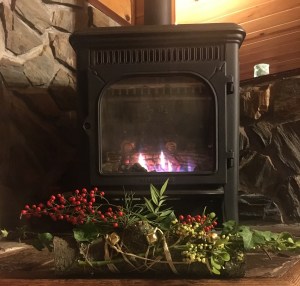 the idea. In addition, caroling, bells, and candles also come from the yuletide season. The two traditions, Yule and Christmas, have blended together in many ways, yet are distinct. This year, the twelve days of Yule are from December 22nd to January 2nd. However, most years the yuletide season runs from December 21st to January 1st. Anytime during this period can be spent decorating the home with wreaths and garlands, or decorating a Yule log to burn one evening.
 though this memory is a few years old, I recall that the intention we used was something like ‘I persist and complete tasks with ease.’ Like the photo here, we have to climb our way out of things and it can feel tiring with life’s hurdles, but our perception matters. We can sprinkle our climb with rose petals (gentle intention supported with loving affirmation). When cultivating an appropriate intention for hypnotherapy or a meditation practice such as yoga nidra, I often rely more on intuition. This is because I am operating from a bit of a different space – after all with CBT, it’s more analytical. In both cases, for me, there is embodiment, mirroring, and attunement, yet CBT adds analysis of thought and behavior. When I relax and tap in to the heart center, and get out of my head, I have found that a trusted intention naturally emerges for myself or for a client or group. Here are some examples that one of my yoga teachers, Dr. Desai, shared with me:
 an end date, one can also be created as a reminder to keep our internal compass pointed in a particular direction. Think empowerment! Daily affirmations can enhance and fuel the totality of the vision board experience. This visual tool is as powerful as intentions and affirmations themselves. To learn more, write me or attend my vision board class in Auburn, CA this December.
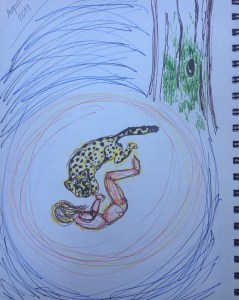 Two nights ago, and to my surprise, youthful Cheetah (a cat native to the other side of the planet) appeared in my dream. It is possible that the wild dream cat was a young mountain lion, as they also have spots when little. While not yet appearing to be fully grown, the facial patterning was remarkable. I gazed at his face and into his eyes. Near the end of the dream, we curled up together and went to sleep.
 dreams of their owners. Bonnie and her cat Jessie still meet in dreams, even though Jessie died in 2012. Jessie was a tuxedo cat, meaning that the cat’s coat was mostly black with some white patterning on the front part of the body. Bonnie told me that Jessie often comes into her dreams. Mia has appeared in her mom’s (the owner’s) dreams throughout the years – even after she crossed over.
 I spent time speaking with young Greeks, and even a few older ones. As I walked through downtown Thessaloniki, not for from Aristotle Square by the sea, I walk past 4th century monuments and wait…what?… yes, vendors selling Native American dreamcatchers. What a surprise! Young, contemporary Greeks call these oneiropagida yet they do not have a similar object from their own, forgotten, ancient dream-focused culture. Evidence for this lost culture is mostly found in museums nowadays, especially within the boundaries of my recent trip. One man, who is in his 20s, shared two opposing views of today’s Greek people. Dreams either mean little-to-nothing, he told me, or dreams must be interpreted, as they hold significance for some. For the latter group, oneirokritis or dream dictionaries, however, are popular. He considered those who use dream interpretation to be “superstitious,” yet as we spoke further, I understood that this term was not necessarily negative. The 21 year-old woman who was selling dreamcatchers, among other objects and souveniers, told me that for her and her friends, dreams were not meaningful. She said that her mother, however, carries a belief that night dreams are worth paying attention to and may lead to an action if they seemed meaningful. This isn’t a daily practice though, as some dreams hold more weight than other dreams.
 information about the healing nature of snakes as we looked at a marble relief being sold there, which features Asclepius. A fourth century BCE relief depicts three stages of healing of a patient by the god Asclepius with two apotropaic eyes above. The healing ritual shown here appears to depict Asclepius giving injections and using snake venom as a healing substance. Some believe that Asclepius could transform into a healing serpent himself. The original can be found in the sanctuary of Amphiaraos at Oropos (Attica). Apotropaic magic refers to the power to avert evil or harmful influences, bad luck, misfortune, or the evil eye. Its popularity is evident, even today, by the vast number of apotropaic amulets sold worldwide. Other copies of votive offerings to Asclepius also feature the serpent. Snakes can be found in numerous pieces
  of jewelry (bracelets and earrings in particular) worn by the ancient Greek/Macedonian peoples. We discussed how the serpent, or snake, was considered a strong healing, transformative force historically, yet with the arrival of Christianity, this all changed. From then on, snakes were primarily associated with women and evil, or the devil, thus connecting the two. This myth continues to hold strong today. Then, she asked for me to help her understand a puzzling dream of her own. I say that I’m honored to listen, but cannot interpret another’s dream, as I am not the author of it. She agrees that dreams belong to the dreamer, and continues. We play the game, “If it were my dream,” and have an enlightening discussion. She smiles as her eyes widen,
  expressing thanks for my view on this dream, as if it were my own, revealing a positive resolution in the end. Dreams belong to the dreamer, yes, and isn’t it wonderful to have those that will listen and take them seriously. For these exchanges offer fresh insights and perspectives. I was delighted over my time spent in the museum and with it’s employees – they had much to say about Asclepius and healing, while the others I spoke with knew little, or nothing at all of that part of local ancient history.
 also known as a Herkimer Diamond, under the covers with me. Both stones are credited for enhancing dream recall as well as vivid qualities of the dream itself. I have found that to be the case in my experience when working with these stones. Those are my top two go-to stones. Others swear by any kind of quartz crystal. Part of creating a space for conscious dreaming is the preparation ritual. It’s easy to bypass this part, yet intention is a key element behind any and all rituals. For example, I sometimes burn a mugwort leaf in my bedroom – it’s a highly regarded ancient incense, you know! I’ve also used locally-crafted tinctures as well as essential oil based body oils infused with mugwort. No matter what I use, it is necessary to set the intention for the goal to manifest.
 See it already happening!
 Their mission is directed toward human consciousness – specifically increasing it through the method of dreaming. The founder and co-founder have experienced lucid dreams and understand the great potential that accessing conscious dream states have for humanity. Since I couldn’t agree more, I turned to them when I found myself in a slump, with significantly reduced dream recall and a low level of awareness in my dreams (What I mean by that, is that when a dream scene turned so bizarre where I would normally question whether I was dreaming, I did not. That meant no lucid dream for me!). But, also, as I said, I was just deeply curious, having never tried a dietary supplement created solely for lucid dreaming. It sounded exciting. Some authors who write about dreaming have expressed the benefits dreamleaf’s featured red pill/blue pill product called dreamleaf. I decided to purchase it. So far, I have not experienced the results I was hoping for, yet I have only used each supplement about a half-dozen times. I’m sure I’ll give it another shot soon.
 pill (the dreamleaf dietary supplement in my case). Call me old-fashioned, haha, but I must admit that I feel best when I know that I have worked for the results. At the same time, sometimes I just want a break from it all without losing the benefits. This year, I’ll settle on experiencing both. But I won’t lie – truth is, I have found the most impactful, memorable lessons of human consciousness capability by going the long route. Through harnessing the skills, extraordinary experiences are also replicable, and can be done at will by more advanced practitioners. Waking up is a process. By just relying on external consumables, when the pills run out, what then? The conflict is real – LOL. When I give myself a hard time, I remind myself that nature is here for us. We are nature. Medicinal plants have helped people in numerous ways for millennia. When coupled with intention – the power of the mind – there is no stopping us from expanding consciousness.
 Conscious Chimera