No one needs to convince us why we need to breathe. Sometimes, however, we need convincing as to why we should do it consciously, with awareness. Study after study shows us that intentional, abdominal breathing has direct affects on the body – this is good news. After all, it is free and can be done anywhere, at any time. Stress doesn’t have to get the best of us! By just a few minutes spent each day on the practices I’ll be describing below, one can invoke healing in the immune and nervous systems. This stuff calms the mind as well. Don’t we all need that, especially during this time?
When I demonstrate these techniques to my patients, I first begin by putting one hand on my chest and the other hand on my abdomen. This sort of check-in tells me whether I’m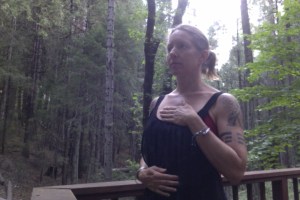 breathing into my chest (shallow breathing) or whether I am taking a fuller breath in so that my belly expands (this is what we want). If my breathing is in my chest, I can consciously imagine my next inhalation moving deeper down into my body. I do this – as many breaths as it takes – until abdominal breathing is comfortable. Try it for yourself now. See what I mean?
From there, I love to move on to the 4:8 breathing technique. This is done by inhaling for 4 seconds, pausing for a second, then exhaling for 8 seconds. Simple, right? I like to do this for about 5 rounds or so. At that point I am really starting to notice the effects. The 4:8 breathing technique is so wonderfully calming.
Another way to encourage this kind of slow, rhythmic breathing is to use visualization. This was taught to me by one of my best yoga nidra teachers, Kamini Desai, PhD. With each exhalation, image that you are blowing the air out through a straw. So that’s inhaling through the nose, pausing for a second, then exhaling with softly pursed lips as if blowing through a straw. Really see that breath being pushed out through a skinny tube to slow everything down.
Another technique that involves counting, but in a much different way, is to count each inhalation and exhalation. Work downward, from 10 down to one. Some people recommend counting only the inhalations or the exhalations, while others recommend counting both. So, it would look like mentally/silently saying to yourself ‘10 I am inhaling…10 I am exhaling…9 I am inhaling…9 I am exhaling…8 I am inhaling,…’ and so on. When I was training in hypnotherapy, I was reminded that counting down (not up) was important to encourage greater levels of relaxation.
We all know that stress equals disease onset. In our overly-stressed society, conscious breathing has become a necessity. Not only do our bodies benefit, so do our minds. After all, the mind and body are linked – they make up a whole. You could even say that they are ONE. While these techniques are for anytime and anywhere, I find that they are perfect upon waking up each morning as well as at bedtime. That’s because an AM breathing practice sets the tone for the day, while the PM practice supports the melting away of stress and the day’s residue. It even adds to a solid sleep hygiene routine. With consistent practice, I expect that you will see a difference. I know I did.
If you’d like one-on-one coaching for stress management or support with your health goals, contact me. I can assist you in breathwork and in building a mediation practice. I offer guided imagery, hypnotherapy, and yoga nidra (a sleep-based meditation), in addition to counseling services.
Here’s to your health,
Kim
To order my book, Extraordinary Dreams, click here.



 I spent time speaking with young Greeks, and even a few older ones. As I walked through downtown Thessaloniki, not for from Aristotle Square by the sea, I walk past 4th century monuments and wait…what?… yes, vendors selling Native American dreamcatchers. What a surprise! Young, contemporary Greeks call these oneiropagida yet they do not have a similar object from their own, forgotten, ancient dream-focused culture. Evidence for this lost culture is mostly found in museums nowadays, especially within the boundaries of my recent trip. One man, who is in his 20s, shared two opposing views of today’s Greek people. Dreams either mean little-to-nothing, he told me, or dreams must be interpreted, as they hold significance for some. For the latter group, oneirokritis or dream dictionaries, however, are popular. He considered those who use dream interpretation to be “superstitious,” yet as we spoke further, I understood that this term was not necessarily negative. The 21 year-old woman who was selling dreamcatchers, among other objects and souveniers, told me that for her and her friends, dreams were not meaningful. She said that her mother, however, carries a belief that night dreams are worth paying attention to and may lead to an action if they seemed meaningful. This isn’t a daily practice though, as some dreams hold more weight than other dreams.
 information about the healing nature of snakes as we looked at a marble relief being sold there, which features Asclepius. A fourth century BCE relief depicts three stages of healing of a patient by the god Asclepius with two apotropaic eyes above. The healing ritual shown here appears to depict Asclepius giving injections and using snake venom as a healing substance. Some believe that Asclepius could transform into a healing serpent himself. The original can be found in the sanctuary of Amphiaraos at Oropos (Attica). Apotropaic magic refers to the power to avert evil or harmful influences, bad luck, misfortune, or the evil eye. Its popularity is evident, even today, by the vast number of apotropaic amulets sold worldwide. Other copies of votive offerings to Asclepius also feature the serpent. Snakes can be found in numerous pieces
  of jewelry (bracelets and earrings in particular) worn by the ancient Greek/Macedonian peoples. We discussed how the serpent, or snake, was considered a strong healing, transformative force historically, yet with the arrival of Christianity, this all changed. From then on, snakes were primarily associated with women and evil, or the devil, thus connecting the two. This myth continues to hold strong today. Then, she asked for me to help her understand a puzzling dream of her own. I say that I’m honored to listen, but cannot interpret another’s dream, as I am not the author of it. She agrees that dreams belong to the dreamer, and continues. We play the game, “If it were my dream,” and have an enlightening discussion. She smiles as her eyes widen,
  expressing thanks for my view on this dream, as if it were my own, revealing a positive resolution in the end. Dreams belong to the dreamer, yes, and isn’t it wonderful to have those that will listen and take them seriously. For these exchanges offer fresh insights and perspectives. I was delighted over my time spent in the museum and with it’s employees – they had much to say about Asclepius and healing, while the others I spoke with knew little, or nothing at all of that part of local ancient history.
 Conscious Chimera