the waking nightmare

It’s very likely you’ve had a dream of being chased, under the threat of harm. This is one of the most common nightmares. Nightmares often play out in a similar fashion.

A common script:

Dream turns scary.

Dreamer retreats, desperate to escape.

Dream continues to unfold in unbearable ways.

Dreamer resists and will do almost anything to change what is.

Whether being chased by a hungry, wild animal, serial killer, or scary monster, we run – and fast! Would it be a surprise if I told you that not every runs away? Would it shock you if I told you that some dreamers turn directly toward what is feared?

By facing what, at first, seems scary and instead, engaging with it, transformation is possible. What we resist, persists, as the saying goes. The old habit of turning away is challenged. By refusing to acknowledge or listen to the messages of the dream source, we are likely to continue to be chased, haunted, or frightened. Imagine what could unfold by regarding nightmarish dream figures as helpful messengers. With some attention and gentle confrontation, once startling figures, may turn out to be the bearers of important news, or carry personal messages meant to be shared with the dreamer. For example, the dreamer may learn of a developing illness in need of medical attention, or an addiction spinning out of control, or an aspect of oneself needing acknowledgment and care, all as a result of engaging a frightening or bothersome dream figure.

But why, if we are meant to understand something, wouldn’t the dream figure appear in a more gentle form? If it did, would we pay attention? In his book, Conscious dreaming: A spiritual path for everyday life, Robert Moss suggests that dreamers ask, “What am I running from?” People so often run from things that cannot be controlled. img_1914Also consider that if we run when chased, could we be running away from an aspect of ourself? Behaviors and attitudes in waking life closely reflect those in dreams, and the behaviors and attitudes in dream states are a familiar reflection of waking life. Avoidance or denial in the dream state, for instance, is likely to spill over into the waking state, and vice versa. In addition, one’s most unpleasant aspects, false ego, or unhealthy choices may manifest in unattractive, dirty, or even ugly imagery. Such imagery cannot be ignored. Yes, we wake up frightened, but we remember.

What better way to gain insight into all of this then to ask the dream adversary itself? With some lucidity or conscious awareness in the dream, we can ask, “What message do you have for me?” “Why are you chasing me?” Or, “What do you represent?” Dreams have so much to offer – they can reveal so much to those who are willing to listen and pat attention. What do we have to lose? After all, by fleeing in either state – dream or waking – a similar challenge will await us on the other side. For instance, we may notice addictions or unhealthy behavioral distractions surface when the nightmare is not confronted. In the end, there is nowhere to hide. Moss asks, “What are the shapes of your deepest fears and insecurities?” He adds, “You can count on your dreams to show them to you, over and over, until you have grown beyond them. Thus nightmares often present recurring themes. You are falling – maybe because you don’t yet realize you can fly.” I believe that dreams have a way of acting as a compass would. The highest compass – the soul’s compass – will always steer us in the direction of growth and toward the highest good.

Interested in working with dreams? Psychologists and psychotherapists specializing in dreamwork can be found all over the world. The International Association for the Study of Dreams (IASD) – the world’s largest professional dream association – is a good place to start. As an IASD Board Member, I can help you find a dreamworker near you. My services are currently being offered in San Francisco and Nevada City, California. Email me anytime!

Additionally, the IASD will be offering an online dream conference from September 23 through October 7, 2018. The online platform allows for greater accessibility to those around the world, so I am really excited to connect with other dreamers abroad. I will be presenting a paper titled ‘Extraordinary Announcing Dreams.’ For more information, visit http://iasdconferences.org/psi2018/

Please consider joining us,

Kim


my IASD conference experience

Last week, I returned from the 35th annual conference of the IASD, that is, the International Association for the Study of Dreams, which was held in Arizona this year. img_1928IASD conferences hold a special place in my heart, not only for the cutting-edge workshops and research presentations (such as Dr. Krippner’s shown here), but also for the soulful attendees as well. To spend 5 days with a large group of professionals, who hold such love for dreams and dreaming, is precious indeed. The interdisciplinary inclusion really makes these events special. Discussing dream research and holding space for dreamwork processes with so many psychologists, anthropologists, students, physicians, authors, psychiatrists, artists, psychotherapists and other healers is a true learning experience. It was img_1918also exciting to deliver a workshop and share my recently published book, Extraordinary Dreams, with people from all over the world – those I only get to see once a year. And while I have been attending IASD conferences since 2012, this year I became a Board member. There will be much to learn in this new position.
Something I habitually do before departing for an IASD conference is to chose a recent ‘big’ dream that I will focus on or work with during dreamwork process workshops. One year, for example, I chose a memorable tornado dream, and this year, I chose my most recent, which has turned out to be the most potent, mountain lion dream. While I gain a great deal of intellectual stimulation from the research presentations, it is the dreamwork sessions that leave me relating to my ‘big’ dreams much more deeply than before I arrived. They help me to keep the evolving relationship with the dream characters alive and come to deeper levels of meaning.

Many art-centered dream workshops I have attended, and loved, include two dimensional creations, such as, creative writing, drawing, painting, collage. This year, there was one workshop I attended that incorporated a three dimensional quality. The workshop leader brought 3-D pieces (woodscraps, beads, pipecleaners, sticks, tissue paper), and with these, the attendees were asked to create the dream or reflect dream characters three-dimensionally. This made a real difference for me because I could show others aspects of my mountain lion dream in ways that were difficult two-dimensionally. What’s more, I could move the pieces around when needed. This allowed me to ‘communicate’ in ways I had not been able to before and helped me to understand the greater ‘constellation’ of the dream in a new way.

Sometimes, we may not be able to find the time to create 3-D objects of all dream characters from scratch, but we may be able to use other 3-D objects already at hand, such as children’s toys lying around the house (or the therapy office for those of us that work with children). Small dolls, stuffed animals, Lego figurines, etc. can take the place of hand-made objects. This can be beneficial to the dreamer, who may not have access to other means of exploring dreams in 3-D space, such as in group work. In groups, each member can play the roll of a dream character for the dreamer. That, too, is a luxury, because dream groups are not held in every city, every week or month, let allow ones with a Gestalt orientation. Without willing participant bodies consistently available or personalized hand-made dream representations, easily available objects could suffice. Do any of you relate to your dreams in this way? I’m glad I had the opportunity to try it out because it left a strong impression.

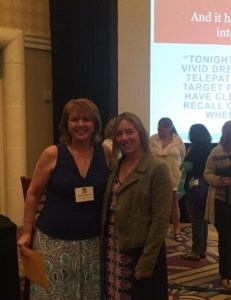
In addition to workshops, other creative activities abound at IASD conferences. There is img_2033a dream telepathy contest modeled off of New York’s Maimonides Medical Center telepathy experiments from decades ago under Dr. Ullman and Dr. Krippner (here I am with Maureen, “the sender” for this years contest), a dream art exhibition featuring fine art in various media from artists worldwide, and on the final evening, a dream ball where attendees dress in a costume from a dream and are invited to share the dream if desired. If you missed us this year, you can find us –and the fun- next year. IASD’s 2019 conference will be held in Kerkrade, Netherlands. For more information, go to www.asdreams.org


Hope to see you there,

Kim

do you have a lucid mindset?

More and more people are becoming familiar with the concept of lucid dreaming, or dreaming while knowing that you are dreaming. Would you like to learn how to experience this wonderfully amazing state? For starters, there are some basics to understand as you dive in. This month’s article will feature Dr. Clare Johnson’s “golden tools” for a lucid mindset, particularly, the first of her three golden tools: Intent.

Now before taking a good look at our intention for dreaming consciously, it is necessary to note the importance of using a dream journal. Logging dreams as a daily practice builds our relationship with them. By doing so, we are essentially telling ourselves how important our dreams are and that they are worthy of our attention and our time. Some people use a basic notepad, but I like to use journals that are special and more decorative or unique from the everyday notebooks that I use to jot down ideas or thoughts. This spring, I met Al Martínez of Da-Vínch Studios in Grass Valley, California. img_1823I was amazed by his craftsmanship, and the time he dedicated to making one-of-a-kind handmade books and journals. I thought, “Now this is a real dream journal – one to hold my most meaningful lucid dreams.” Here is Al in the construction process.

Once we are well on our way to recording our dreams, no matter how vague, short, or mundane, we can trust that more will come. Once we make this habitual, it’s a fine time to seriously consider our intention – Dr. Johnson’s first golden tool. She notes that setting a basic intention such as, “I want to have a lucid dream” is too broad, too empty. Instead, get specific and bring the intention alive by feeling excitement and liveliness for the journey you are embarking on. Furthermore, investigate the specific action you want to take in the lucid dream. Spend time thinking about this action as you go about your day. For example, I decided that I wanted to visit Egypt’s Giza Plateau the next time I became lucid in a dream. And how would I do this? By lucidly flying in my dream body, of course! During my waking hours, in preparation, I spent time looking at colorful photos of the pyramids and wondered what it would be like to fly across the country and the sea. Would I be able to control my speed? Would I be able to see the ground and sea below? (In one particularly memorable experience, I found that, yes, I was able to do these things in my lucid dream excursion to the Giza Plateau, and it was truly amazing).

Before going to sleep, lie quietly and imagine successfully experiencing your chosen action. This sets a strong intention, and the likelihood of recalling your plan in the dream state will be higher. Dr. Johnson reminds us that sometimes we prefer not to change the lucid dream, instead going along with whatever unfolds. If this is the case, as we lie down, we can imagine how awesome it would be to explore the lucid dream space, consciously taking in the details. Do not underestimate the practice of visualization. It really does support conscious dream experiences.

Another way of setting intent is to draw a picture or make a collage of your intended lucid dream action, according to Dr. Johnson. I have yet to do this, but plan to start adding this creative element to my repertoire, as it sounds powerfully effective. What a way to engage willpower, curiosity and enthusiasm!

Finally, we can elicit assistance from our dreaming mind. Offer gratitude for a fulfilling lucid dream, or “strike a deal,” as Dr. Johnson suggests. For example, ask your dreaming mind to help you become lucid in exchange for keeping a consistent dream journaling practice. You may begin noticing lucidity cues. Dr. Johnson began making mixed media collages to enhance her dream imagery, only later to notice that the collages began to turn up in her dreams as a cue to become lucid. She shares other striking examples, so, I suggest taking a look at her book to discover them.

I hope this has inspired you to set an intention for your dream life, as we may spend anywhere between 45-60 hours a week sleeping. Dreaming lucidly, consciously, can change not just the way we experience sleep, but the way we experience the waking state, our day-to day existence. Truly, it can change our lives.

Wishing you restful sleep and peaceful dreams,

Kim

*Find Dr. Clare Johnson’s second and third ‘golden tools for a lucid mindset’ in her book Llewellyn’s Complete Book of Lucid Dreaming: A Comprehensive Guide to Promote Creativity, Overcome Sleep Disturbances & Enhance Health and Wellness.

*To reach Al Martínez of Da-Vínch Studios directly (and see photos of his gorgeous hand-crafted journals), email him at davinchstudios@gmail.com

hypnopompic inspiration

The science of sleep has continued to gain attention and over the past couple of decades the field of sleep medicine has experienced a boom. According to American Sleep Association, there are two forms of sleep related hallucinations: hypnogogic and hypnopompic. Some researchers, however, note that the term hallucination is unfitting because hallucinations only occur in the full waking state. Firstly, hypnogogia, is the term used to describe the state one experiences just before sleep. In this state, one may experience hallucinations and sleep paralysis. Secondly, hypnopompia, is the term used to describe the state one experiences upon waking. Sleep paralysis is common during this period, along with perceived complex visual imagery, and increased dream recall.

These sleep-related states can serve creative types well. My own experiences have resulted in decision making, speech writing, and artistic creativity. Others have discovered solutions to complex problems and have even composed musical pieces. When we pay attention and attend to the lived experience of these states, possibilities become endless.

Allow me to share a recent hypnopompic episode. As I was awakening one morning, I saw a strong and fairly clear image that puzzled me. There was a simple wooden wall or plank, with a bright red heart (like a paper valentine’s day-like cut-out heart) floating near the top-left side. To the right was a vertical column of silvery milagros or ex-voto. 649932E1-5FF1-4A6B-B0A3-2EA9E29E6F48Unfortunately, I could not hold on to the exact ones, but I’m certain that they were all body parts. There were at least four, but likely many more. I brought the image to my dream group and processed its many possible meanings. Still, the image stuck with me and I began to draw it, then paint it (I now have plans to construct it in the near future). Through the artistic process my relationship to the meaning behind the raw imagery developed. This style of dreamwork can evolve over a long period of time leading to greater insight and awareness of one’s soul journey. So much of this space remains private, but I am beginning to reveal more and more in time. This image, in its many forms will be on public display in two art exhibitions this spring and summer. I’m excited to share more of my inner work with others and discuss how sleep related states have created meaning in the lives of my community.

Shamans and practitioners of traditional ways do not necessarily label or compartmentalize the human experience the way the West does. No matter which labels (hallucinations, etc.) Western science applies, sleep related states have a long history of supporting spiritual growth and development in many areas (business, career, marriage, creativity). With a pen and paper by the bedside, and a set intention, so much can be unleashed.

Be well,

Kim

To order my book, Extraordinary Dreams, click here.


today’s meditation

Last month (Nov. 2017), I concluded the Conscious Chimera article by revealing my openness for dreaming with a deceased loved one that night. I awoke the next morning, November 1st, surprised, yet appreciative, for during an early morning dream I answered a phone call from my deceased paternal grandmother. Wow – I dream with her so rarely! In the dream, we spoke briefly, similar to our phone calls when she was living. She told me she was fine and asked how the family was doing. After our check-in, and knowing that everyone was doing well in general, we ended the conversation. Then, I woke up. This dream was not nearly as profound as the dream I had immediately prior to her death, but I am always grateful for whatever way the grandmother-granddaughter relationship can continue. For this month, I decided to write about an important practice: mediation. A meditation routine supports dreamwork as well as good health. So, that is what I present here, today.

As I sat this morning, on my turquoise cushion, tracking my breathing – each inhale and each exhale – I realized I had not written on this aspect on conscious experience since conscious chimera began. “Not now,” said an inner voice, silently disciplining the mind. As any experienced meditator knows, another distracting thought is just around the corner. Anything to take us away from the task of following the breath, or staying with img_2452present awareness. New associations, distant memories, dinner planning – it doesn’t matter, we know distractions arise. While simple, disciplining the mind is no easy task. We learn to gently become the boss of our conscious attention. The mind can argue with us about this. “You can do this meditation thing later, the kitchen needs cleaning… weren’t you supposed to call your mother!” Staying with the practice is an important aspect of the practice itself. Additionally, as we increase awareness in the waking state, we may discover increased awareness in the dream state.

Over the past decade or so, I’ve been fortunate enough to have been taught meditation, as a sitting practice, by contemporary mindfulness practitioners as well as by those immersed in Buddhist-centered traditions (Tibetan Shambhala is one example). But that is not how I began. At 19, my introduction to meditation began with primarily movement-based practices. My Tai Chi and Qi Gong instructors were exactly what I needed in my early years. Back then, it was difficult for me to sit still and nearly impossible to jump right in to tracking thoughts and disengaging mental chatter. Those early experiences served me well and built the foundation for what was to come. Later, in the mid-2000s, I was introduced to a focusing type of meditation, which involved vocalizing vowels (e.g. “Aaaaaaaaahh”). This proved effective in many ways. The practice was active, but in a new way, and the shift in the mediation space was palpable, thus reinforcing. Dedication to those exercises, as a result, took dreamtime to a new level, giving rise to desired lucid experiences.

From my own history of meditation, I have come to view the mind as sort of an entity, with its own agenda. It doesn’t want to sit still. It doesn’t want to go quiet. For me, it seems to enjoy planning for the future and fantasizing about adventure. Fortunately, with practice, there is noticed improvement. Not only can our health and general functioning improve, but we come to see that we do not have to react to the junk life throws our way. There is no need to respond to that mental ‘director’ that does not 12079055_842446395876012_8916130318488297582_nalways know what is best for us. After all, it is not our true essence. The irony is that through sustained, ongoing meditation practice, we come to experience truth, connection to the all and everything…our true essence, our very nature. And sometimes, our practice can lead to a creative project, like a written piece for a blog, such as this one.


If you have never meditated before, but want to start, commit to 10 minutes a day to start. Literally, schedule it – put it on your calendar. Then, at the appropriate time, silence the phone, TV, radio, etc., find a comfortable place to sit, set a timer for 10 minutes, and simply focus on your breath. Mentally track each inhale and exhale. When you catch the mind wandering, come back to the breath. It’s not a contest – if the mind wants to judge or ridicule, fine, but the task for the 10 minute period is to focus on the breath, so just come back that rhythmic cycle again and again, as often as needed. After a solid week (or month) increase the sitting time by 5 minutes. See what you discover from the simple daily 10 minute routine. You might discover something new, when in dreaming or waking.

Questions? Comments? Contact me! I’d love to hear how your meditation practice has enhanced your lived experience, whether asleep or awake.

~Kim

reflections on working with the living & the dead

The year has flown by and here we are, again, at that time when so many of the world’s people turn their attention to the dead. Samhain, Dia de los Muertos, All Soul’s Day, All Saint’s Day, Festival of Hungry Ghosts (recently passed) – each one is different, but they each share some similar elements, and sometimes similar activities, such an making offerings or prayer.

Connecting with a deceased loved one is possible, no matter whether you engage in hypnosis, dreaming, deep prayer, imaginal journeying, altar-making, or use a black mirror, the fire place, quartz crystals, or what-have-you. Regardless of the object used or state induced, even a brief connection can hold tremendous meaning for those grieving or for those simply wanting to remember. My most preferred methods are dreaming and hypnosis, as both have offered positive experiences along with profound and memorable results. Any method, tool, or nonordinary conscious state can be accessed individually, but group work also holds promise, especially with an experienced therapist, medicine person, or guide.Il tavolo

One potent ritual involves constructing an altar. While I currently offer altar-making in individual psychotherapy sessions, many years ago, I co-led an altar-making and process group with another therapist. The attendees comprised of teenagers and pre-adolescents with unresolved grief/loss issues from loosing a parent or family member to ‘the life’ – a term referring to street life, addiction, overdose. Even though some of the participant’s parents died during the participant’s early childhood years, there was no shortage of memorabilia, stories, or recollections. The act of constructing the altar itself elicited spontaneous memories of shared experiences that were previously believed to be forgotten. By this, I mean that when asked directly to share a story from long ago, many children could not produce one, however, that all changed when they entered this collective ‘sacred’ container, or space, where the memory of the deceased was very much alive. Near the end of the weeks-long process, the attendees reported that the experience left them feeling closer to the deceased loved one, and this turned tears into smiles. Gratitude and peace were married in this new way of remembering.

Large-scale community altar-making has also left an impression. I participated in these activities in Arizona. I discovered that community bonds strengthen in meaningful ways when people join together to make offerings, blessings, or witness one another in prayer to deceased loved ones. These sizable collective altars were modifiable and continued to expand for days. They were multi-cultural in the truest sense. While I am no longer an Arizona resident, I still know the ritual continues, and I sit here in California today, Nonnityping this, shifting through recollections.

At this time, as I turn my attention to the dead, seven female elders immediately come to mind: Mary, Anne, Eva, Florinda, ‘Nonni’/Netta, Maria, and Censina. I feel so fortunate to hold a clear memory of each one, even though most of them (and their spouses) transitioned when I was still a child. Also at this time, I add extra flowers, fresh water, and dust off the prayer cards on the family altar that stands year-round in my home. If I am extra lucky, I will get a visit…who knows, maybe even in tonight’s dream.


May the veil be thin,

Kim

dreaming in recovery

While working as a trauma therapist at a non-profit agency for substance abuse recovery, I meet all kinds of women. The clientele are highly diverse, yet they come together in their recovery journey. Whether in an individual or a group therapy session, the topic of dreaming often emerges even though I do not advertise my experience as a dreamworker or dream researcher. Dreams in early and mid-stages of recovery surface and are shared. The question often asked is “why now?” and “what does this mean?”

“Dreams belong to the dreamer,” I state, “so you are the one to determine that.” My offer to share some prominent theories, in order to generate ideas, is met with approval. One perspective of dreaming is that dreams come in service of evolution. They act as a protective evolutionary factor. In this case, if a woman is striving to stay clean (and recover from long-term drug abuse), a drug-of-choice dream might remind her of her purpose and this most pressing issue.

In the dream, sometimes the dreamer simply looks at, or holds, a bag containing the drug-of-choice; other times she prepares to consume the illicit drug, but awakens before doing so. And even other times, dreamers use the drug while in the dream state .Perhaps these three examples represent levels or stages of recovery integration. Or, perhaps they exist simply to encourage the dreamer to progress in some way.

In the first example, some of these dreamers have spoken about a feeling of mastery or pride in that they could be so close to such a dangerously tempting substance, yet not act impulsively or have any desire to do so. In the second example, dreamers have reported feeling worried about their dream activities (e.g. chopping a line; preparing a syringe), only to become increasingly vigilant in their recovery work. The third and final example can leave the dreamer with much confusion and fear. One woman reported smoking crack cocaine in a dream, and while slowing waking up (aka hypnopompic state), she touched her face, perceiving it as thinner and sunken in. This perception led her heart to race and body to jolt out of bed in fear. The dream, she said, upon reflection, supported her recovery by scaring her out of thoughts of using. The cravings dissipated for some time and she made several statements about her commitment to her recovery.

Substance abuse is like a slow death. It is, essentially, self-harm and the illicit drug is the weapon. For those living with addiction, the drug-of-choice is extremely powerful – powerful enough to hijack, sabotage, and rob a person of their own life. If dreams do serve evolution, then a dream centered around the relationship and power dynamic between the drug and the dreamer, may support relapse prevention or prepare the dreamer for what could come.

Addiction is a chronic disease. It can cause disability and premature death, but it can be managed and people do recover. The resources listed below can offer help and provide information, however, they are just a starting place.

http://www.asam.org

http://www.na.org

http://www.smartrecovery.org

http://www.womenforsobriety.org/beta2/

taemong

Parents, grandparents and other family members report dreams about children-to-be. Most often it is women who experience such dreams, typically occurring around the time of conception or during pregnancy. These episodes have been referred to as conceptions dreams, fertility dreams, and even announcing dreams. I consider announcing dreams to not only feature the child-to-be metaphorically (a small furry animal or a seed are examples), but to also serve as a communication between the baby and dreamer.

Taemong, or Korean birth dreams, first came to my attention from the 1989 book Oriental Birth Dreams by Fred Jeremy Seligson. Later, Associate professor, Loren Goodman, PhD, of Yonsei University expanded my view significantly. Taemong are part of a long oral history within Korean culture. They typically do not feature the child-to-be as a human baby, but instead as an animal or jewel for example. As the saying goes, “One cannot come into this world without first having been dreamt.” We can show the dreamer a lot about who we are and who we will become from such powerful dreams.

Not so long ago, Koreans, and others interested in taemong, have begun to collect and transcribe these stories. Dr. Goodman told me that taemong are not usually written down, but instead, passed on orally. He is one among many who recognize the importance of recording this extensive tradition so it does not become lost. Without doing so, it may very well likely die out as we become an evermore globalized society, abandoning traditional practices and culturally-specific ways of knowing.

Dr. Goodman expanded my view and understanding of this rich cultural tradition. He told me that many narrative elements emerge from taemong. Some of the elements stood out to me because I noticed that these elements also emerged from the announcing dream reports I have been collecting for the past decade. These ‘shared’ narrative elements are suddenness, brightness, brilliance or illumination, enormity (size) or miraculous proportions, vividness or a quality of being unforgettable, and reciprocal gaze. Consider the following dream (the full version was posted in June 2017). The dreamer saw an adult size baby boy kneeling on the floor by her bedside. The dreamer stated,

“He was leaning on my bed, watching my husband and I sleeping. When I got up to look at 17800279_10154857591042949_1533489294192211638_nhim, he calmly whispered, “I’m coming.” This freaked me out, because it was the first time a baby had ever appeared…”

This dreamer told me that the dream-baby appeared suddenly, out of nowhere, and was huge – nothing like the size of a typical baby. She said that the dream was vivid and truly unforgettable. The elements of suddenness, enormity, and quality of being unforgettable/vividness all exist here – these are common among taemong. Here, though, the baby-to-be speaks to the dreaming mother.

The following taemong was provided by Yoon Ha Park, a student of Dr. Goodman:

As I am walking alongside a lake, I see the clear sky suddenly change dark. I try to get a better look at what is happening above. From high above the sky, I spot an enormous dragon gracefully, yet powerfully, make its way towards the lake in front of me. It sinks in the lake and pulls out its head and looks at me directly in the eyes. Strangely, despite its vast size and figure, I don’t feel afraid.

The narrative elements here are suddenness, enormity, and reciprocal gaze.

The two dreams shared here (the first an announcing dream, and the second a taemong) share similar elements. This appears to be the case for many dreams that are recalled around the time of pregnancy, whether they are categorized as conception dreams, fertility dreams, announcing dreams, or Korean birth dreams. A thorough analysis to encompass all of these categories could provide an expanded understanding and further clarity. Until that happens, it is clear that these types of episodes are common and meaningful for so many families.

I wish to thank Fred Jeremy Seligson, Loren Goodman, Yoon Ha Park and the anonymous dreamer for their assistance, guidance and for sharing with me their experiences.


In the Spirit of Peace,

Kim

mutual dreaming


Can two or more people (even complete strangers) share dream elements? Can two or more people agree to dream together and intentionally interact? Dreamers casually talk about these episodes. A significant body of anecdotal reports exists as well. Still, scientific investigations in this area are rare.

About two decades ago, I had my first dream of a stranger, which I met later, for the first time, in the waking state, a few weeks after the dream. She was a young woman close to my age. While I recalled information about her from the dream, she did not recall dreaming me. This episode was one-directional, although many people report dual-directional experiences.

The term ‘shared dreaming’ usually refers to two or more people sharing similar elements in the dreams. ‘Mutual dreaming’ involves two or more people interacting or meeting together in a dream. I see it as more intentional. Both shared dreaming and mutual dreaming can involve highly detailed recollections or vague memories.

Once a month, I lead a dream course in California. One time, as the participants departed, a man approached me and asked if I had ever heard of two people having the same dream. I said, “yes,” and told him that this phenomenon has been reported by many people. He then told me about a recent experience he had with a friend. He said they seemed to share the same dream space and awoke to recall very similar events and scenes. After listening to his story, I asked if he or his friend had written down the episodes before speaking to each other – they hadn’t. I suggested dream journaling upon awakening. Not only would this document the dream for future reference, but it would also say a lot if both dreamers produce similar written episodes before interactional influences have an effect. We parted ways, both excited that this might occur again soon.

While I was aware of the varieties of anomalous dream occurrences much earlier, it wasn’t until about 2004 that I attended courses and participated with a group that taught lucid dreaming and out-of-body techniques. During that period, the group would meet about once a month at night to practice mutual and shared dreaming – a special occasion. One of the group facilitators would place a secret object in the next room and the attendees were invited to dream with each other, interact, and if they chose, discover the object unknown to the group. This was a fun challenge and my first time working with a group to enhance our conscious dream skills. I was unsuccessful, but those more seasoned participants were quite successful, at times, and made accurate claims regarding the target object. During those years I came to understand that mutual and shared dreaming is possible.

Neuroscientist Patrick McNamara, PhD asks Can Two People Have The Same Dream? (See June 19, 2016 article in Psychology Today by that name). McNamara states that the best-documented cases involve shared dreams between therapists and their clients, followed by those people in close relationships. Think emotional closeness! While McNamara notes that the dreamers don’t agree on every dream detail, I understand that to be consistent with reports from waking state occurrences. For example, two friends walking together side-by-side down the same street would likely not report the exact same details of the experience. Psychological theories of memory, sensation and perception explain this. As McNamara’s article concludes, he writes, “In short, we [the scientific community] have no good explanations for shared dreams. Perhaps that is why science has not yet investigated these events. Science has no place to put them within its current worldview—but this is all the more reason to investigate them. Paradigm-challenging phenomena are the most important data for science because they force revolutionary changes.” I can think of no bigger clash than that of the current scientific paradigm and the transpersonal or spiritual perspectives.

Western science aside, consider non-materialistic views and those traditional, nature-based, indigenous, non-western, or even mystical views. Can consciousness leave the physical body and return at will? If the soul travels as one’s body slumbers, bumping into friends or family members who share the same ‘dimensional space’ may be possible. While such a notion is a given among certain groups, it may not sit comfortably with particular religious groups or even extreme secularists. Mutual and shared dreaming rides dangerously close to historical accusations (Salem witch trails; the Inquisition) of individuals making a pact with the devil. Whatever we believe, it is unlikely that the next person that crosses our path will hold the same assumption or harness the same belief. The bottom line, however, is that it may be difficult to deny the power and mystery of mutual dreaming once one (or more) experiences such.


Be well,

Kim