For the month of November, Conscious Chimera is featuring a recent article written by Roshan Fernandez and Sarah Young of Monte Vista High School. This article appears in El Estoque, a publication of Monte Vista High School (Cupertino, CA), and includes interviews of IASD board members, myself included. I hope you enjoy the article – I think they did a fantastic job.
Dream Theory
Experts interpret the meaning and importance of dreams
Roshan Fernandez and Sarah Young
October 24, 2018
When she found herself wondering whether her relationship was healthy, whether there would be a future, she turned to an unlikely source for guidance: her dreams.
“I asked [myself] when I was asleep, ‘Dreaming mind, show me what I need to know about this situation.’ And then in the dream, my boyfriend at the time was driving unsafely in the car, and [he] brought us to our home, which was a barren shack. And there was a little more detail, but that helped me think, ‘Ok I’m being cared for or driven in an unsafe manner to a place with nothing.’ And that’s all I needed to know.”
Dr. Kimberly Mascaro, a board member for the International Association for the Study of Dreams (IASD), cited this anecdote from her personal life as a way of explaining how dreams can be helpful. In addition to the scenario above, she explains that dreams have helped her make important decisions about her career.
But beyond the helpful aspect of dreams, Mascaro’s interest has shifted towards the field of extraordinary dreams, a category which includes the more unusual types of dreaming. Among these are precognitive dreams, which is when one dreams of an event that may happen in the future. Though there is anecdotal evidence that people may foresee extreme catastrophes in their dreams, she says precognitive dreams are usually more mellow.
“[Some] people saw 9/11 in their dreams before it happened and they couldn’t make sense of the event, they just did not understand what they were seeing,” Mascaro said. “[But] what we find is in precognitive dreams is usually … basic stuff like … the wrong package being delivered to your door. It’s really benign stuff like that.”
The science behind precognitive dreams is still unclear, but Mascaro believes the answers lie within theoretical physics. Research in this field can help explain how a dream can predict a future event.
“We contemporary Westerners really only have one understanding of time, which is very linear,” Mascaro said. “Other cultures have a different understanding of time which is not linear — it may be a sort of circle or something like that.”
Although precognitive dreams have not been clearly defined, Mascaro explains that it’s still important to pursue research in these types of fields and emphasizes the the importance of paying attention to one’s dreams. Her IASD colleague, Athena Kolinski, expands on this, explaining that one dreams about the things that are important to them.
“Your intuition speaks to you from whatever you know and whatever you understand,” Kolinski said. “So as you gain more information on these subjects, it can speak to you, sending you symbols [through your dreams].”
In order to put those pieces together, the IASD holds conferences that attract people from all over the world. Through both an annual conference as well as numerous regional conferences, people have the opportunity to delve deeper into the different areas of dreams through seminars, workshops and presentations. These conferences are held across the world, including past events in Anaheim, Calif., Scottsdale, Ariz. and the 2019 conference will be held in the Netherlands.
Personally, Kolinski enjoys workshops where people share their dreams and the entire group discusses them. She emphasizes, however, that nobody else has the right to definitively tell someone what their dream means –– they can only offer their opinion.
“The dreamer is always the ultimate authority of their dream, so nobody has the right to say ‘this is what your dream means absolutely,’ that’s not how it works,” Kolinski said.
Even when someone else is sharing their dream, Kolinski says that she is still gaining something from it. Because we all have different ideas about the way the world works, she says hearing someone else’s point of view is beneficial.
“When we’re hearing a dream, we’re interpreting it from what we know in our own mind,” Kolinski said. “When I or anybody gives an example of what the dream means, we have to own our projection, so we have to say ‘If this were my dream, I think it means ‘blank.’”
Dr. Angel Morgan, another member of the IASD, is a firm believer in what she calls ‘dream circles.’ With a group of people listening, the dreamer explains their dream and the others listen, reflecting on what they believe it means. According to Morgan, these can be powerful interactions that really help the dreamer gain understanding. She recalls a particular example, where the group was re-enacting the scene of a girl’s nightmare.
“She had a dream that a troll and a dragon were chasing her around a coffee table … so she cast a boy in the group as the dragon and a girl in the group as a troll. I asked her how she felt, and she said I feel scared, I feel helpless, I feel silly,” Morgan said. “And I said why don’t you turn around and chase them, and she said OK. And [after that] they all started laughing because it was funny, and it just made her feel so much better about the dream.”
This kind of ‘therapy’ seems to be helpful, but one thing the IASD discourages is dream dictionaries. These are books that people may reference to find the meaning of particular symbols that appear in their dreams. Morgan and Kolinski encourage group discussion, as opposed to referencing a dream dictionary, because every person’s mind works in a different way.
“Say for instance, you dream of a rose. And then the dream book says its about love and fertility, so you’re already set in that that’s what it means. But the reality is, what if I’m dreaming about a rose, and the rose reminds me of my grandmother named Rose,” Kolinski said. “So we always need to look at the personal meaning, not just what happens in our dream but deeper, what is that symbol connecting us to, what is it saying. That’s something only you know.”
Dr. Steven Nouriani agrees with this as a practicing psychotherapist. He believes that dreams have multiple layers to them, originating from an individual’s life and relationships and stemming from the state of unconsciousness.
“There’s this whole theoretical model that we have [an] unconscious and [a] conscious,” Nouriani said. “We believe dreams come from … the unconscious — the psyche is [constantly] trying to balance our consciousness with our unconsciousness.”
Nouriani follows the Jungian belief, a way of thinking that emphasizes the individual psyche and personal quest for wholeness. Following this, dreams reflect the unconscious and internal conflicts. When he hears a client’s dream, Nouriani takes a deeper look at the symbols from a Jungian perspective.
“Jungians have an amplification method in which we go beyond the symbols and try to apply what we know about mythology and fairytales and culture,” Nouriani said. “So, for example, the dog [symbol] can have different stories in fairy tales or mythology, and then we bring these other kind of associations at the cultural level to understand what other meanings these symbols might have.”
Similar to Kolinski, Nouriani looks for symbols in dreams and what these symbols mean to the individual.
“No two dreams are alike; they are always different,” Nouriani said. “The same way that your thumbprint is different from someone else’s — you have the same thumb as other people but the thumb print is still different, and so you have to have a certain level of expertise to decipher the meaning.”
One thing all of these experts share in common is they all encourage individuals to record their dreams and think about their meaning. With dreams being so intrinsically connected to the unique individual, Kolinski, Mascaro, Morgan and Nouriani are there to provide guidance, but never insert meaning.
“We all believe dreams are just there and we can understand them — we have to work with the person to understand,” Nouriani said. “It’s good for people to be interested in dreams because they constantly try to help us be more conscious; I encourage everyone to pay attention to their dreams and wonder what they mean. They help us grow and they help us develop.”
Many blessings this Samhain, Day of the Dead, All Soul’s Day & All Saint’s Day,
Kim
 IASD conferences hold a special place in my heart, not only for the cutting-edge workshops and research presentations (such as Dr. Krippner’s shown here), but also for the soulful attendees as well. To spend 5 days with a large group of professionals, who hold such love for dreams and dreaming, is precious indeed. The interdisciplinary inclusion really makes these events special. Discussing dream research and holding space for dreamwork processes with so many psychologists, anthropologists, students, physicians, authors, psychiatrists, artists, psychotherapists and other healers is a true learning experience. It was
  also exciting to deliver a workshop and share my recently published book, Extraordinary Dreams, with people from all over the world – those I only get to see once a year. And while I have been attending IASD conferences since 2012, this year I became a Board member. There will be much to learn in this new position.
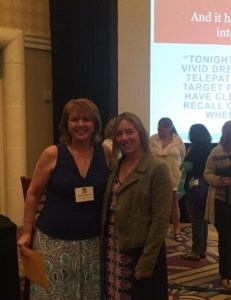 a dream telepathy contest modeled off of New York’s Maimonides Medical Center telepathy experiments from decades ago under Dr. Ullman and Dr. Krippner (here I am with Maureen, “the sender” for this years contest), a dream art exhibition featuring fine art in various media from artists worldwide, and on the final evening, a dream ball where attendees dress in a costume from a dream and are invited to share the dream if desired. If you missed us this year, you can find us –and the fun- next year. IASD’s 2019 conference will be held in Kerkrade, Netherlands. For more information, go to
 typing this, shifting through recollections.
 Of course, we are not limited by this planet alone. We can fly into deep space or to other planets. Many years ago, a woman told me that she flew to the planet Venus in her lucid dream and was certain that some kind of life form existed there. I became quite curious, but to this day, I have never made it there.
 above it. Look around and see what you notice. If instead, you find yourself lucid in a more natural landscape, fly to the top of a tree or mountain. Notice what can be observed from this new vantage point. No matter what happens, you can wake up (returning to the physical waking state) simply by saying, “I want to wake up now.” That’s what I said during my first recognizable lucid dream and I immediately found my awareness there in my bed. My eyes opened and the episode was over.
 Conscious Chimera