Welcome back Conscious Chimera followers! You may remember Dr. Teri Jackson from the last blog – the anniversary article! Since she is so wonderfully valuable in the world of integrative healthcare, I’ve invited her back. She graciously agreed and will teach us a bit about a type of Western Medicine known as homeopathy. Enjoy!
As our discussion began, Dr. Teri Jackson (TJ) provided some history: Homeopathy was developed by the German physician Dr. Samuel Hahnemann. His observation as a medical doctor was that many of the medications at the time were highly toxic. Things that we wouldn’t even think of as having a medical application today, such as toxic substances mercury and arsenic, were used as medicines. Dr. Hahnemann considered how these medical applications that are toxic could somehow be beneficial. He asked, Is there a way that we can still preserve the health benefits of these toxic substances while removing the toxicity? So his idea was to dilute them to the point to where they still have their medical application, but they didn’t have any more toxicity associated with them. So that’s where homeopathy started from. So Dr. Hahnemann would take something like mercury diluted down hundreds of times in order to have this medicine that was no longer the way it was supposed to. So that’s the very basic tenet of homeopathy.
KM: It reminds me of how vaccinations work as well. There’s some diluting down of a substance.
TJ: Yes, that’s actually an excellent point. Now while vaccinations and homeopathy are not exact – not the same thing – it can be helpful for our modern mind to think about it in a similar way. So, with a vaccination we take virus or some other agent that will normally cause illness in a person, we then dilute it down, inject it into that person so their immune system can then identify that particular agent and attack it, and therefore support the immune system of the person. Homeopathy works in a very similar way in that when we’re giving a diluted version of a medication, it isn’t the remedy itself that’s actually effecting change in the person. Instead, it’s hitting their energetic system. As a vaccine will affect the immune system of a person, homeopathy addresses the energetic system of a person.
KM: Western medical practice seems to have forgotten about its past inclusion of energetics.
TJ: Yes, and in fact, for centuries, we had homeopathic hospitals and universities. In 1910, things shifted when the Flexnor Report was published via the Carnegie Foundation, essentially stating that natural modalities were bunk, and that all medical interventions should be
pharmaceutically driven. Prior to that, it was rather acceptable that natural remedies, including homeopathy, were part of any doctor’s tool kit.
KM: Yes. I recall a little bit about what you’re saying.
TJ: So what homeopathic remedies affect is what we call the vital force (of a person). In other traditions, such as Ayurvedic Indian traditions, we call it prana. In Chinese medicine, we call it Chi or Qi. In Western traditions, we call it the vital force. So just as acupuncture in Chinese medicine affects the chi/qi system, homeopathy, similarly affects the vital force. Basically, homeopathy works with the same energetic system as acupuncture.
KM: Okay, so vital force is the term that is used in the Western system, compared with prone or chi/qi in other systems. Thanks for bringing that up.
TJ: So the answer to your question about vaccinations that’s exactly how it works. It’s basically taking the diluted substance and triggering the innate vital force response of the person to self-heal and self-regulate.
KM: I see, that’s really great. Can you tell us about particular homeopathic remedies and their uses or applications?
TJ: Sure! There’s a concept in homeopathy called miasmatic theory. Certain attributes are passed down the generations and from a biological, physiologic genetic standpoint we understand this. We get our genes passed down from our parents, grandparents, great grandparents, and these certain attributes, physical, mental, emotional, are passed down and that’s something that we know and understand to be true. There’s another layer to that story that I think we talked about in our last blog interview, which was epigenetics. And that’s how our genetic code the DNA is concrete, but the expression of those genes can change depending on our environment (food, diet, stress levels, trauma are examples), all of those different types of expressions of genes are also passed down through the generations.
So this dovetails nicely with this homeopathic idea of miasm, which is that there are these core traits that we have as individuals that are passed down through the generations. And one of these miasms is the cancer miasm. So, Causticum, for example, is a cancer remedy in homeopathy. So is Carcinosin. These are remedies that although the constellation of symptoms are not exactly the same, the miasm is that of cancer. So, we understand that cancer can run in families and it goes beyond just genetic mutations. There is a constellation of characteristics and attributes that are passed down and then they manifest in several ways, so there are several cancer remedies.
KM: Since you named Causticum first, and I am also familiar with that remedy, please say a little more about how it can be helpful.
TJ: Causticum is one of the remedies for anxiety. Also, lesions and sores on the skin that have a burning quality. Also, we look at the personalities of the people and match the remedy to that personality as well.
KM: That’s right, because you’re treating the whole person – mind, body, spirit, emotional, all of that.
TJ: So sometimes I’ll ask a patient, “What makes you mad? What are the kinds of things that really anger you?” Someone with a Causticum constitution would reply with injustice, social injustice. Now people get can get angry about all sorts of different things. So if a person comes to me, and their primary complaint is anger, I’m not just going to give them a remedy for anger. I need to know what makes them angry. Why are you angry? With what are you most angry about? Out of social injustice? Are you angry because you’re holding on to a child resentment? It’s different for everybody. And so that’s where we have to understand not only the physical symptoms that a remedy can address, but also the personality traits.
KM: Yeah, good. Good points to remind us that we want to think in a more holistic way and an open minded way with these types of treatments, treating again the whole person. So you said there were hundreds and hundreds of homeopathic remedies.
TJ: Yes, there are literally hundreds of homeopathic remedies. The most commonly prescribed remedies are called polycrests. These are the ones you can find in the little blue tubs at health food or natural stores. Arnica is the one most people are familiar with which is known to help superficial things such as bruising and strained muscles. Polycrests are the very commonly used remedies that address a very broad range of symptoms.
KM: What else should we know about in this world of homeopathy. Anything specific to be aware of?
TJ: So the tricky thing with homeopathy is that as a layperson without training, if you’re going pick out a remedy for yourself, it really is a shot in the dark. One of the great challenges is choosing the correct remedy! Untrained people might think that homeopathy doesn’t work because they’ve chosen a remedy for themselves that is not the correct one.
That being said, there are some really commonly used remedies for certain mental emotional conditions. An example is grief. The big grief remedies are Ignatia and Natrum-mur. These are remedies that you can consider if you’re feeling grief stricken. Phosphorus and Arsenicum are two that are really good remedies for anxiety. But again, the underlying “pathology” is what is necessary to understand in order to choose the correct mental emotional remedy. It’s very individualized.
KM: That’s why it is so important to work with a trained professional.
TJ: Yes. While there are lay homeopaths, generally speaking, people who practice homeopathy either are a naturopathic physician like I am, or a medical doctor – many are practicing homeopathy. There are also certification courses that will certify lay homeopaths. Lay homeopaths are people who do not have a medical degree, but do have advanced training. And depending on the state, these people may or may not be licensed to practice medicine. In which case there would just be more of a consultant.
KM: Yeah, it does differ state by state. It’s really nice to learn more about this. Thank you for this introduction to homeopathy! A take-home-point for me is that we are much more than just a blob of matter. We are mind, emotion, and spirit as well.
TJ: And energetics!
KM: Right! I’d say that there are many kinds of medicine helpers, in different ways, and in different systems. Of course, consult with your health care provider. But the different systems can work well together.
TJ: Absolutely. These modalities are not mutually exclusive. Just like you use, you know, a lot of pain management clinics will utilize chiropractic or acupuncture. That doesn’t mean that you can’t do both. You can do traditional pain management along with these other modalities.
KM: Any last words before we wrap up?
TJ: Again, they are not mutually exclusive.
KM: That’s such an important reminder, that it does not have to be one or the other. We can choose integrative medicine.
Thank you for taking the time today to allow me to interview you!


 deeper, something critical for long-term survival and prosperity. This lack is rooted in the spiritual (not to be confused with religious dogma). We have collectively lost our divine feminine soul.
 collaboration. Those qualities enliven feminine energy and when they are lived through the body and move the spirit, we touch the divine feminine.
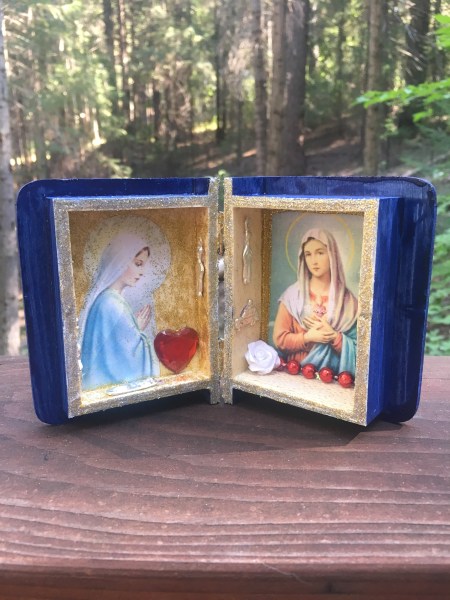
 me in a few directions. I had found myself drawn to meditate on the Goddess: Gaia, Brigid, Diana/Artemis, among others – this surfaced years ago. This year, I have returned to bring home an aspect of my Roman Catholic roots. That is turning my attention back to the Blessed Mother, Mother Mary, the Madonna. In addition to meditation and contemplation, I have opened myself to a kind of creativity that blends these ingredients by crafting small shrines in Her honor. As a longtime artist and craftsperson, I see how my consciousness shifts when I get into ‘the art zone.’ Time freezes, senses come alive, thoughts cease, and something bigger opens. This is just my current way of doing things and experiencing the mysteries of the process. I am no expert when it comes to the Divine Feminine. Like everyone else, I search for meaning.
 I spent time speaking with young Greeks, and even a few older ones. As I walked through downtown Thessaloniki, not for from Aristotle Square by the sea, I walk past 4th century monuments and wait…what?… yes, vendors selling Native American dreamcatchers. What a surprise! Young, contemporary Greeks call these oneiropagida yet they do not have a similar object from their own, forgotten, ancient dream-focused culture. Evidence for this lost culture is mostly found in museums nowadays, especially within the boundaries of my recent trip. One man, who is in his 20s, shared two opposing views of today’s Greek people. Dreams either mean little-to-nothing, he told me, or dreams must be interpreted, as they hold significance for some. For the latter group, oneirokritis or dream dictionaries, however, are popular. He considered those who use dream interpretation to be “superstitious,” yet as we spoke further, I understood that this term was not necessarily negative. The 21 year-old woman who was selling dreamcatchers, among other objects and souveniers, told me that for her and her friends, dreams were not meaningful. She said that her mother, however, carries a belief that night dreams are worth paying attention to and may lead to an action if they seemed meaningful. This isn’t a daily practice though, as some dreams hold more weight than other dreams.
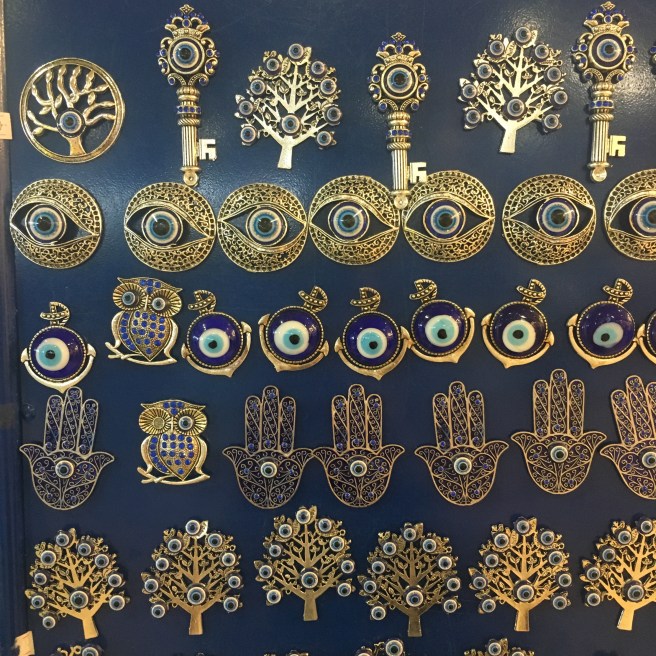
 information about the healing nature of snakes as we looked at a marble relief being sold there, which features Asclepius. A fourth century BCE relief depicts three stages of healing of a patient by the god Asclepius with two apotropaic eyes above. The healing ritual shown here appears to depict Asclepius giving injections and using snake venom as a healing substance. Some believe that Asclepius could transform into a healing serpent himself. The original can be found in the sanctuary of Amphiaraos at Oropos (Attica). Apotropaic magic refers to the power to avert evil or harmful influences, bad luck, misfortune, or the evil eye. Its popularity is evident, even today, by the vast number of apotropaic amulets sold worldwide. Other copies of votive offerings to Asclepius also feature the serpent. Snakes can be found in numerous pieces
  of jewelry (bracelets and earrings in particular) worn by the ancient Greek/Macedonian peoples. We discussed how the serpent, or snake, was considered a strong healing, transformative force historically, yet with the arrival of Christianity, this all changed. From then on, snakes were primarily associated with women and evil, or the devil, thus connecting the two. This myth continues to hold strong today. Then, she asked for me to help her understand a puzzling dream of her own. I say that I’m honored to listen, but cannot interpret another’s dream, as I am not the author of it. She agrees that dreams belong to the dreamer, and continues. We play the game, “If it were my dream,” and have an enlightening discussion. She smiles as her eyes widen,
  expressing thanks for my view on this dream, as if it were my own, revealing a positive resolution in the end. Dreams belong to the dreamer, yes, and isn’t it wonderful to have those that will listen and take them seriously. For these exchanges offer fresh insights and perspectives. I was delighted over my time spent in the museum and with it’s employees – they had much to say about Asclepius and healing, while the others I spoke with knew little, or nothing at all of that part of local ancient history.
 Conscious Chimera