biohacking and dreaming: an unlikely pair?

What are you willing to do in order to be at your very best?

How far would you go? Which risks are really worth it?

Since there are so many aspects of and so many options for bio-hacking these days, ranging from age old practices to contemporary ones, just about anyone can give it a try. From oral supplements, dietary changes, injections, IV therapies, external/wearable physiological tracking devices, implantable biotechnologies, and more, just about anyone with extra income can bio-hack their body, in one fashion or another, in an attempt to reverse aging, elevate performance, and increase vitality. I have found some of the methods to be quite extreme. But couldn’t one engage in biohacking for little-to-no-cost with little-to-no risk by utilizing their innate gifts? I would say so, and that is through attentive engagement with sleep, especially dreaming. While napping and extra long hours of nightly sleep can be viewed as a luxury, the free practices of dream incubation, as well as lucid dreaming, can open up a whole new world. Such nonordinary or altered-state-of-consciousness biohacking is low-level and safe. Double-bonus: these no-cost strategies, skills, and techniques can take as little as 10 minutes out of your day (or night, depending). First, I will share some words about the practice known as dream incubation, then I will say a little about lucid dreams and how they might relate to hacking our biology.

Photo by Tembela Bohle on Pexels.com

Biohacking is all the rage these days, the latest DIY (do-it-yourself) craze. You can find dissertations written on the topic, as well as, articles published over the last 14-15 years in journals like Nature Biotechnology (2009), BioSocieties (2017), and Futures (2021), differentiating between biomedical citizen scientists and fringe biohackers, alongside how hobbyist, activism, art and science intersect within a DIYbio landscape. Here, they note the risks involved, and the fact that research on such “hidden populations” brings with it many challenges. Even Forbes has highlighted the topic over the last couple of years. DIYbio practitioners, or biohackers, are increasing in number and the phenomena itself is increasing in popularity with each passing year. And why shouldn’t it? Everyone wants to be at the top of their game, and to feel that sense of control when it comes to taking charge of experiencing optimal health, peak performance, with the hopes of extending living with quality over one’s lifespan. 

Dream incubation can be used for a wide array of needs. It is an ancient practice. Dream incubation involves sending out an intention before a nap or bedtime to ask for guidance and knowledge. The manner by which one sets up a dream incubation ritual can be simple or complex. The ritual aspect is important because effective rituals are done with great focus and intention – never autopilot. Dream incubation is at home in the biohacker world because it can be utilized for diagnosing or better understanding health-related conditions or concerns and in support of healing those.

DISCLAIMER: The information in this article is for educational and entertainment purposes only. The information provided here is NOT a substitute for medical care. If you have any medical issue, of any kind, please go see a physician. 

Okay, now back to dream incubation. Possible questions or statements to include as part of the dream incubation process could be any of the following – but be ready, knowing that what you ask for, you just may well receive.

 “Show me a mirror that can allow me to see into my body, revealing health or illness.”

“Which foods are best for my unique makeup?”

“Show me the supplements my body needs right now for XYZ.”

“What practices I do at this time in my life for peak performance?”

“Show me a solution to this problem (or situation or issue).”

“What area of my life needs my attention right now?” 

“How can I heal from this?”

“Please give me a direct healing in my dream.”

“Take me to the time and place where the root cause of this problem came to life.”

“Show me the circumstances surrounding this concern I have.”

You may also craft your own, of course – Just be sure it is done in the positive and affirmative. Make the question or statement short and to the point. Once you have one, write it down on a piece of paper while expressing it out loud. Proclaim it. Then, place that paper under your pillow. Once you are in bed, cozy and comfortable, focus on the statement or question you chose as you drift into dreamland.

Write down, draw or sketch out, or if you prefer, audio record anything you recall immediately upon waking up from the dream. Keep at it – use one intention for a full week or even two. This consistency increases its effectiveness. Once you have something, reflect. You may do a daily reflection, or wait until you have recollections accumulated from a few days of practice. I’ll add an important point here: anything a dream provides – all wisdom coming out of the dream world – deserves a thank you offering, even an offering as simple as a prayer is fine. You don’t necessarily have to offer up an object. What comes with including dreams into the bio-hackers world, is a relationship. This way of working is not a secular transaction. I’ll say more about this in the final paragraph of this article.

Photo by RDNE Stock project on Pexels.com

I’ve practiced dream incubation quite a bit for many reasons. Years ago when I was searching for healing and cures in the dream state due to a medical condition I faced, I would regularly begin my evening with a dream incubation ritual. For some nights my recall seemed nonexistent while other times I awoke with a lot of quality information relevant to my situation. One time in the dream, a colleague who also happened to be an amazing lucid dreamer appeared right in front of me, holding “the cure” in her hands. It was a frame drum made from natural materials, slightly larger than the ones I was used to seeing. I awoke immediately after this very direct and clear wisdom was provided. I awoke angry, and sad, because after having spent years studying traditional healing ways as a, primarily scholarly endeavor, I knew what “a call” looked like and how they could appeared. Even worse, I knew what happens to those who do not follow through…those who “refuse the call.” So that this story remains a short one, I am sure you can guess what I did. That was to begin the multi-year long training with a noted, quality teacher and surrender as I embark on the deep, deep dive. Even though I was exhausted, overwhelmed, and frankly, just didn’t want to to do it, I did so regardless of the investments of time and cost. This path includes ceremonies that honor the gifts that emerge from the altered state practices, so many prayers are offered, naturally. So, while a free biohacker support, dream incubation can lead to something you might not want to do, or even want to know. Therefore, be clear before you proceed.

Now let’s move on to lucid dreaming. As for those of you who lucid dream skillfully and fairly regularly, you can use any of the statements or questions above in the lucid dream state. You might address the dreamscape first. I’ll share an example from one of my own experiences with lucid dreaming and healing. Upon becoming lucid, I called out, “Dreaming Mind, show me how to heal this condition!” I have also asked, “Dreaming Mind, what is the root cause of this condition?” Additionally, “Dream, take me to XYZ so I may understand XYZ.” Remain open and receptive to what is shown or revealed in that lucid state. Again, write down, sketch out, or audio record anything you recall upon waking up from the dream. But, of course, do not jump out of bed so quickly. Remain still for a few moments as you collect yourself, mentally gathering together what you recall from the experience.

While lucid dreaming is as popular as biohacking these days, remember that lucidity does not equate to superiority. Ordinary dreams are truth teller. In addition, the liminal zones, in fact, offer some of the best information out there, so do not dismiss them. By this, I mean, as you relax prior to sleep, stay alert enough to catch solutions whether they arise as sounds, voices, or images that may come forth before drifting off to sleep. This pre-sleep zone is rich in what it can offer. On that note, be aware when you are awakening as well, as it is another valuable time period for gaining insights and catching solutions. These are the liminal states of consciousness. Some time ago when I was dealing with a condition and using the dream arts as part of my healing protocol, I heard a strong and direct voice in a liminal state. It was a teacher of mine reminding me how the body knows how to heal itself (given the right conditions). While not a diagnosis nor a remedy per se, the liminal dream did inspire me. The experience also served as a reminder for me to provide the correct, necessary conditions so that I may move along toward a state of healing from within.  

Photo by Mikhail Nilov on Pexels.com

No matter which dreamy state you find yourself in, remember to remain physically still as your awareness rises in order to enhance recall, whether those dreams be ordinary, liminal or lucid. Treat them all with the same respect. May your dreams be your medicine, as I always say! Stay open and receptive. Allow yourself to be surprised.

I’ll wrap up by returning to a point I made earlier. That is, how important it is to act on any and all information your dreaming mind gifts you. “Dreams require action,” as Robert Moss has said. So, do something to honor the dream. In addition to ceremonial prayer, one of the other ways I have done so is through creating art. I have made paintings based of what I saw and sensed in my lucid dreams, as well as collaged images from ordinary dreams that threw me for a loop as a way to process and understand them in deeper and deeper ways. Poetry or song are other possibilities. And since we are talking about bio-hacking here, be sure to visit your doctor anytime a dreams shows you a possible or potential illness or medical condition brewing. It’s better to be safe than sorry.

Happy 2024,

Dr. Kim

be like water

Celebrating our 7th Anniversary this week, Conscious Chimera is dedicating this blog-article to the main substance of our being. That is, water.

Years ago, when I was immersed in training in Wing Tsun, a form of Kung Fu, my Si-hing would always say, “Be like water.” I learned this way of movement and relating to life from the discipline of Wing Tsun. A lived commitment to this fluid, formless, yet effective martial art was shown through a consistent practice of yielding…just how water does. A deep bow of respect to Grandmasters Ip Man, Leung Ting, and Bruce Lee for bringing this wise way of being into the western world. After I had moved on from my physical Wing Tsun training, the psycho-spiritual realities of Wing Tsun stuck with my for a long time. As time continues to pass, I began to forget.

It wasn’t until years later, when I relocated to Maui, that an oceanic state of consciousness would permeate my entire being. And then, those words from long ago –  ‘be like water’ –  would be recalled along with how water flows without resistance. Water has no rigidity. It yields, gracefully moving past obstacles. How could I be more like water on my new island home? Would its attributes permeate me while being completely surrounded by it? Allowing life to flow without a structured plan for the future, without familiar surroundings and routine, all the while without resistance to fluidity and unfamiliarity, may naturally arise when one lives this close to water…if we allow it. Such a state of consciousness could do us the favor of slowing us down, and of existing in the now.

During my last few years in California, I lived in the mountains and forests with its deeply dense, heavy energy. A switch to now residing in the most remote island chain in the world has many blessings, especially as a water sign (I’m a Pisces), yet it has spun me around quite a bit. Some days I found a part of myself just didn’t give a f*@# about fast-paced productivity, yet I knew I had to work, to produce, to survive. This is evidenced by the absence of a January blog post – ha!

As a part of nature, and in relationship with it, I value nature as a primary tool for grounding and connecting to Source. So, having the ocean waves crashing in (literally a five minute walk from the front door) and on me, has surely enhanced its effects. It’s been challenging to make decisions, follow-through on intellectual work-related plans, or even have logic-based conversation. And honestly, I just haven’t been interested in such.

Because I also choose to immerse myself in the ocean water regularly, it completely permeates me. It’s not just on my skin, but inside and through me. The effects of detoxing also come into play. Yes, I have been feeling a bit all over the place. I’d like to think that I can open myself to it, fully surrender to this shift, but some days I sense how a part of me is still grasping on to something I can’t fully explain. A part of me resists. Turns out, it’s not so easy to “be like water.” But I know one thing. The salty detox and mana here are in control. If you want to stay, there’s no point in resisting. 

I’ve written a lot about nonordinary, or altered, states of consciousness, especially here on the Conscious Chimera blog, with a fair amount of personal experience behind my writings, yet what is unfolding here is something different. It’s a dreamlike energy that doesn’t quit. The waking dream is real. Since I haven’t figured it all out yet (haha) I just continue to respect water, pray to water, ask her to protect me upon entering her, and honor this experience of existing in an oceanic state of consciousness…letting go fully so I can see where it takes me. 

In Peace and Wellness,

Dr. Kim

got insomnia? turn down mind-body-spirit noise!

Is insomnia in your self-descriptive vocabulary? I hear this regularly among patients in my clinical practice. Maybe you experience insomnia or sleep next to someone who does. Sleep is natural, but why do so many people struggle with it? Insomnia seems to have become the new normal. Would you agree?

No one is alone here. Sleep disorders are a major concern for millions of people, including young children. Loss of restorative delta sleep (~ 0.1 – 4 hertz)  – that’s the deepest level of sleep –  and loss of REM sleep are both related to a slew health issues, both physical and mental. In Dr. Matthew Walker’s (2017) Why We Sleep: Unlocking the Power of  Sleep and Dreams, he writes, “No facet of the human body is spared the crippling, noxious harm of sleep loss” (p. 133). Sleep loss negatively affects all major systems of the body, including the immune and sympathetic nervous system. Research also shows how cancers are linked with getting 6 hours or less of sleep each night and over-exposure to light at night. There is good reason for making some changes!

Photo by Acharaporn Kamornboonyarush on Pexels.com

But what is sleep? Sleep is holistic, intimately tied to many areas of life. This includes our relationship with the deepest part of our-self, our inner world.

The underlying organizational and foundational structure of sleep is natural  cycles or rhythms (think circadian, ultradian, etc.), body temperature, and a sense of inner peace, according to sleep specialist and clinical assistant professor, Dr. Rubin Naiman of University of Arizona.

Challenges to getting good sleep are much, much more than a biophysical issue. Most people these days are aware of the psychological consequences of sleep loss, such as increased thought distortions, and mood disturbances, as well as loss of attention, concentration, and memory. In children, sleep deprivation leads to what adults describe as ‘behavioral problems.’ It’s really the same with adults. But beyond this, how many are aware of the social and instinctual aspects of sleep?

For those with insomnia, we might consider what we have imposed upon ourselves. One question to ask ourself is “What do I consume?” Beyond consuming food (with lower nutritional value today than decades ago), we also (over)consume various forms of stimulation such as light (electricity, screen time), information (24 hour news), fluids, and energy (aka heat/arousal). Then there’s additional stressors – the good old fashioned kind – such as the quality of our relationships. Chronic inflammation, which underlies all major diseases, and hyperarousal (do you run hot?), which is behind insomnia, are associated with consuming excessive energy/stimulation (aka noise).

Photo by Ketut Subiyanto on Pexels.com

The good news is that we can reset ourselves, just like a pendulum clock. Exposure to nature light early in the morning is the best way, according to some sleep specialists. Greet the sun each morning  – use the moment to connect with Source through meditation or prayer.

Last year I wrote an article which included 10 sleep hygiene tips – Find it here: https://dreamstudies.org/dreammedicine/

And here are a few additional suggestions. In the PM hours, get into a solid ‘sleep hygiene’ routine. Furthermore, use substitutions, such as swapping out coffee (or alcohol) for teas, elixirs, or mocktails. We can also add a 30 minute yoga nidra session into our day or evening. Yoga nidra is a guided sleep-based meditation that “helps restore autonomic nervous system balance,” according to yoga expert, Dr. Kamani Desai. Yoga nidra turns down the heat. This is one antidote for sleep loss (and the tension that builds with ongoing insomnia) since it is designed to gently guide practitioners into deep sleep. It’s so relaxing! If you’d like to join me for yoga nidra, email me. For almost three years now, I have facilitated free yoga nidra sessions. At this time, I invite you to my free, virtual yoga nidra offerings on Wednesdays (6pm Pacific Time) – since it’s online, you can enjoy the relaxation from the comfort of your home. If you prefer pre-recorded sessions, two links to audio recordings can be found near the middle of this page: https://consciouschimera.com/professionalservices/

Since insomnia is much more than a biomedical condition, if you’ve made positive bio-psycho-social-enviromental changes (you’ve turned down the noise) yet still struggle to sleep, you may consider melatonin therapy or pharmaceutical medication. If so, consult with a functional medicine doctor (FMD) or naturopathic doctor (ND) for proper melatonin usage (especially to learn about its anticancer properties) or with a psychiatrist for pharmaceuticals. Like physicians, psychiatrists have earned a M.D., however the vast majority of primary care physicians do not have the training in sleep and psychopharmacology. So, a psychiatrist is recommended. NDs and FMDs are extremely helpful as well. Remember that integrative care is highly supportive, so if you choose to use medication for sleep, you might want to continue with a sleep hygiene routine, and know you are always welcome to join my free online yoga nidra group. If you want to use psychotherapy to treat insomnia, there is also CBT-I, that is Cognitive Behavioral Therapy for Insomnia – the gold standard, with no side effects. I use CBT in my private practice when appropriate as do most therapists. Feel welcome to contact me for support here, especially if nightmares are involved – just click on the Therapy tab on my website, ConsciousChimera.com

Wishing you deep rest,

Dr. Kim

another dream conference begins…

Due to orchestrating a major relocation, I took about six weeks off from writing. The break was helpful. For a short while I forgot that I blog. Sometimes that happens in life – we turn our attention to pressing matters and lose touch with our routine. 

Now that things are starting to settle, I can give my full attention to what’s occurring at the moment. That is, the 39th annual conference of the International Association for the Study of Dreams (IASD). This year, it’s being held in Tucson, Arizona, at a beautiful resort, and Day 1 of 5 begins tomorrow evening. Join us for a day or even the full conference if you are nearby! 

What’s especially enticing is the keynote presenter line-up. I’m really excited to get to see Dr. Stephen LaBerge for the first time. He is one of the few researchers responsible for putting lucid dreaming on the map of western science. If you are unfamiliar with the concept, lucid dreaming is when a person is dreaming while knowing they are dreaming. Prior to LaBerge’s work at Stanford University’s Sleep Laboratory and the work of a handful of other dedicated scientists, the ability to dream fully conscious, that is lucidly, was highly doubted. Even with countless credible anecdotal reports of the phenomenon, those in academia and the sleep research field thought the notion of lucid dreaming was ridiculous. Today, lucid dreaming has been demonstrated in hundreds of sleep studies and has become a hot topic – you can find dozens of symposia on lucid dreaming at IASD conferences.

If you are not a natural lucid dreamer, not to worry. Lucid dreaming is a skill that can be taught. With practice, one can enhance that skill and, well…the amazing adventures await you. Sure, dreaming with awareness can make for great fun, yet it can also offer a space (a dream space, of course) to practice and develop talents and abilities such as improving your golf swing, developing a poem or new musical piece, exploring far away places, and solving challenging math problems. There’s much more one can do while lucid in a dream, but hopefully those examples were enough to whet your appetite.

During a spontaneous lucid dream not terribly long ago, I used my dream awareness to see if I could get some answers to health-related questions of great concern. My dream began as one typically does, then suddenly, something in the dream prompted lucidity and with that spark of awareness, I recalled the health challenge I was facing. I realized this was a precious opportunity, so I called out to the dream space: “Dreaming mind, how do I heal this condition?” and (after a response was given),  “Dreaming mind, what is the root cause of this condition?” The responses I received offered guidance, information, (and some surprises) so that I could consider how to proceed in my healing journey (If you plan to attend this year’s IASD conference, consider sitting in on Tuesday’s Health and Healing Dreams panel, where you’ll find me, along with two colleagues, sharing our research and personal experiences on this topic). 

So why wait until a diagnosis is given? Why not use lucid dreaming as a tool now, at this time in life, in order to inquire into what the physical body may need? There is so much to be explored and discovered through experiencing this phenomenon directly, personally. This is gnosis – knowing through direct experience – rather than through theory or someone else’s descriptions. Direct revelation is powerful, and very personal.

If you are interested in lucid dreaming and want to learn more, including the eastern perspectives and spiritual aspects of this practice (known as dream yoga), check out my book, Dream Medicine: The Intersection Between Wellness and Consciousness (2021). There, you will find multiple perspectives and see what the dozen plus professionals I interviewed have to say about dreaming. Dream Medicine also includes tips, techniques and strategies to get you lucid asap. 

May you know good health. May your dreams be your medicine!

~ Dr. Kim

Dream-based Wellness

Attention to wellness and health have really rose to the surface of human awareness these past two years. Blame it in COVID-19 or perhaps a long awaited shift in consciousness (that piece is of less importance). The value of this attentional shift is that more and more people appear to be taking their heath matters into their own hands. Health practices are vast, spreading across multiple levels, from physiological to spiritual. Recently, I wrote an article for Ryan’s Dream Studies Portal (see https://dreamstudies.org/ if you are unfamiliar with this website). The article I wrote is titled Cultivating your Dream-based Wellness Practice. There, I consider some of the various ways we can participate in our own wellness maintenance and healing, no matter our background or belief system.

Here is a short excerpt from that article: “For anyone’s dream-based wellness practice to bloom healthily, there are things we can do to move it along. I’d like to share some tips for supporting any sort of practice whether it be liminal dream experiences or lucid dreaming. A sleep hygiene routine is the foundation, so I have found. Below are some concrete things you can begin today to encourage the best of outcomes.”

The entire article can be found here: https://dreamstudies.org/dreammedicine/ . Now even if dreams or dreaming are not of high interest at the moment, what you’ll find there are ideas for maintaining wellness through the cold, dark, and sometimes stressful, weeks ahead. As you read over the 10 tips I listed, consider which of them are priority for you this season. Maybe you do many of these already! Or perhaps, these tips will inspire a reorganization of your evenings. It’s a great time to reassess as we enter this new, quickly approaching phase of the year…returning of the light.

Happy Solstice everyone! May your inner light shine bright!

~Dr. Kim

got divine femininity?

We are living in a world lacking balance. This is especially true in modern Western society where patriarchy has imposed definitions of what it means to be feminine. I write from the United States, so my views are birthed from a lifetime of living in this nation. While living in this nation during this era affords so much, it lacks something img_5622deeper, something critical for long-term survival and prosperity. This lack is rooted in the spiritual (not to be confused with religious dogma). We have collectively lost our divine feminine soul.
When we talk about the divine feminine or feminine energy, we are not talking about gender. We are also not talking about modern depictions of women in media who often come across as insecure, jealous, sarcastic, competitive, bitter, resentful or catty – anything but harmonious or spiritually developed. What we are talking about are concepts beyond that, such as creativity, flexibility, wisdom, intuition, community relations, compassion, empathy, sensuality (senses not thought), cooperation and img_5620collaboration. Those qualities enliven feminine energy and when they are lived through the body and move the spirit, we touch the divine feminine.

When it comes to the feminine, it’s easy to lose touch with this part of ourselves. Masculine energies are highly rewarded in this society and have been for a couple thousand years now. Nothing is wrong with these energies when they are in balance with the feminine. As the first sentence highlighted, we are out of balance. Not all is lost though, as we have an opportunity each passing moment to reestablish equilibrium. 

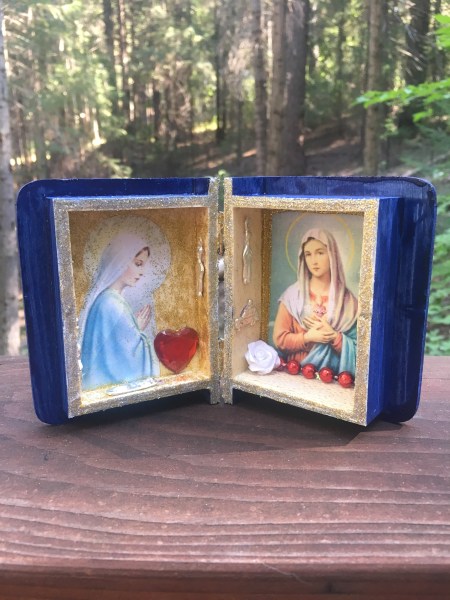
The seven years I spent doing doctoral work alone left me deeply rooted in the head, even though the program was somewhat balanced in that my clinical psychology concentration was somatic psychology – a highly intuitive embodied practice. That said, my personal journey to further restore a masculine-feminine energetic balance has led img_5610me in a few directions. I had found myself drawn to meditate on the Goddess: Gaia, Brigid, Diana/Artemis, among others – this surfaced years ago. This year, I have returned to bring home an aspect of my Roman Catholic roots. That is turning my attention back to the Blessed Mother, Mother Mary, the Madonna. In addition to meditation and contemplation, I have opened myself to a kind of creativity that blends these ingredients by crafting small shrines in Her honor. As a longtime artist and craftsperson, I see how my consciousness shifts when I get into ‘the art zone.’ Time freezes, senses come alive, thoughts cease, and something bigger opens. This is just my current way of doing things and experiencing the mysteries of the process. I am no expert when it comes to the Divine Feminine. Like everyone else, I search for meaning.


While my story and my journey are incomplete (is anything ever complete?), I hope it, along with the photos of my work, inspire you to reconnect to the feminine energy within, in your own unique way. We can revive, reunite, restore and rebuild at any age, at any time. It’s not gone, although sometimes it gets lost. I want to proclaim that we, as humans, have created a balanced world, but I cannot — At least not yet. What are you doing today to bring more balance to your one-of-a-kind life and to this beautiful world?


Compassionately yours,

Dr. Kim

For a free 12 minute guided meditation, CLICK HERE.

To see my shrines for sale, CLICK HERE.

To get my book, Extraordinary Dreams, CLICK HERE.

breathing for health

No one needs to convince us why we need to breathe. Sometimes, however, we need convincing as to why we should do it consciously, with awareness. Study after study shows us that intentional, abdominal breathing has direct affects on the body – this is good news. After all, it is free and can be done anywhere, at any time. Stress doesn’t have to get the best of us! By just a few minutes spent each day on the practices I’ll be describing below, one can invoke healing in the immune and nervous systems. This stuff calms the mind as well. Don’t we all need that, especially during this time?

When I demonstrate these techniques to my patients, I first begin by putting one hand on my chest and the other hand on my abdomen. This sort of check-in tells me whether I’mPhoto on 7-27-20 at 7.34 PM #2 breathing into my chest (shallow breathing) or whether I am taking a fuller breath in so that my belly expands (this is what we want). If my breathing is in my chest, I can consciously imagine my next inhalation moving deeper down into my body. I do this – as many breaths as it takes – until abdominal breathing is comfortable. Try it for yourself now. See what I mean?

From there, I love to move on to the 4:8 breathing technique. This is done by inhaling for 4 seconds, pausing for a second, then exhaling for 8 seconds. Simple, right? I like to do this for about 5 rounds or so. At that point I am really starting to notice the effects. The 4:8 breathing technique is so wonderfully calming.

Another way to encourage this kind of slow, rhythmic breathing is to use visualization. This was taught to me by one of my best yoga nidra teachers, Kamini Desai, PhD. With each exhalation, image that you are blowing the air out through a straw. So that’s inhaling through the nose, pausing for a second, then exhaling with softly pursed lips as if blowing through a straw. Really see that breath being pushed out through a skinny tube to slow everything down.

Another technique that involves counting, but in a much different way, is to count each inhalation and exhalation. Work downward, from 10 down to one. Some people recommend counting only the inhalations or the exhalations, while others recommend counting both. So, it would look like mentally/silently saying to yourself ‘10 I am inhaling…10 I am exhaling…9 I am inhaling…9 I am exhaling…8 I am inhaling,…’ and so on. When I was training in hypnotherapy, I was reminded that counting down (not up) was important to encourage greater levels of relaxation.

We all know that stress equals disease onset. In our overly-stressed society, conscious breathing has become a necessity. Not only do our bodies benefit, so do our minds. After all, the mind and body are linked – they make up a whole. You could even say that they are ONE. While these techniques are for anytime and anywhere, I find that they are perfect upon waking up each morning as well as at bedtime. That’s because an AM breathing practice sets the tone for the day, while the PM practice supports the melting away of stress and the day’s residue. It even adds to a solid sleep hygiene routine. With consistent practice, I expect that you will see a difference. I know I did.

If you’d like one-on-one coaching for stress management or support with your health goals, contact me. I can assist you in breathwork and in building a mediation practice. I offer guided imagery, hypnotherapy, and yoga nidra (a sleep-based meditation), in addition to counseling services.


Here’s to your health,

Kim

To order my book, Extraordinary Dreams, click here.

spirituality’s hidden mask

We are not human beings having a spiritual experience. We are spiritual beings having a human experience. – Pierre Teilhard de Chardin

You are never alone. You are eternally connected with everyone. – Amit Ray

Surely you’ve heard sayings like these before. But have you considered how spirituality intersects with social justice? To believe that the two are separate is a mistake, conveniently ignoring centuries of oppression. Spirituality cannot be divorced from social justice and civil rights issues. To do so is a form of spiritual bypassing, a psychological defense mechanism which does harm.

Spiritual bypassing is a term coined by psychotherapist and Buddhist teacher, John Welwood, in the early 1980s. Spiritual bypassing is the use of spiritual practices and beliefs to avoid unresolved emotional issues and wounds in addition to avoidance of negative or painful feelings. By spiritually bypassing these issues, one sidesteps the difficult inner work, thus adopting more comfortable and “positive” feelings and concepts. Sound familiar? In my experience, it is not uncommon among those in spiritual communities (many of which are White-led, co-opted new-age communities). While this defense mechanism can occur within an individual, it can also live among groups of people. For example, a well-meaning, highly educated, yoga-devoted White man once suggested that attention should be placed on one’s spiritual essence or core rather than concerning oneself with immediate issues in communities of color: the lack of food, safe housing, and job opportunities. Promoting individualism and ignoring the tangible essentials is toxic.

There are many layers to a person – people are complex creatures. The complexity increases as groups and communities form. Psychologist Carl Jung used the term ‘the shadow’ to describe unconscious aspects of ourselves – those aspects we have denied, rejected, despised, or disowned. Without conscious awareness the shadow continues to live – it is hidden. Think of triggers – what are you triggered by? When we disown or cannot tolerate an aspect of ourselves, or our group’s history, it easily gets projected onto other people or other groups. Hate, fear and prejudice are example’s of the shadow operating. Other people become mirrors – they trigger us, giving us a glimpse of our shadow. When we consider how much of what we see in our world today as manifested projections, it’s stunning.

Mindfulness practice can be a first step in beginning to see our shadow because as we slow down, turn inward, and increase awareness we can ‘catch’ projections (even as they are happening in the moment). A simple mindfulness exercise for beginners can be sitting quietly for about 10 minutes with closed eyes and focus on the breath. Notice what arises without judgment (thoughts, memories, future plans, desires, judgments) and return to your breath. With practice, moment-to-moment awareness increases which supports the shadow work process.

While it is easy to judge the shadow as something bad, let’s instead acknowledge that the shadow is just part of being human. It is neither good nor bad. It just is, like the sun rising to bring light and setting to give darkness. When we get a glimpse of our personal or collective shadow it can throw us off, and it can sting! We begin to become aware of our inner moral conflicts. To avoid the discomfort of all this, we are liable to defend ourselves from the pain by using the defense mechanism, spiritual bypassing.

In order to evolve in meaningful ways, we must be grounded in this world and we must face those aspects that we do not want to own. This is the way through these difficult times. ‘Love and light’ is wonderful, but it is not enough. Turning a blind eye to the collective pain currently surfacing only keeps us in denial longer, and it keeps us disengaged from our whole being. Taking meaningful compassionate action rooted in justice for all people is required. To sit back is taking a privileged position. To go silent, to not act, in times of injustice denies our interconnected spiritual nature.

The spiritual life does not remove us from the world but leads us deeper into it.  ― Henri J.M. Nouwen

Dr. Z (drzphd.com) has produced some great videos on #ShadowWork. Here is a link to part 1 of her 6 part series: https://www.youtube.com/watch?v=OHPn5Jtzyhw

Do you reside in California? I am available for individual counseling services for those interested in shadow work.


~Kim

in remission, radical-style

How do people get diagnosed with a terrible disease, forgoing any kind of conventional/allopathic treatment, only to later discover that there is no evidence of that disease? One year, it’s stage four, the next year it is gone – how does this happen? Radical remissions have boggled the mind, however, the spontaneous disappearance of disease is now much more well-documented than it was a half-century ago. The Institute of Noetic Sciences published a report in May 1987: Brendan O’Regan’s lecture, titled Healing, Remission and Miracle Cures. Yes, these types of spontaneous remissions were

fashion woman notebook pen
Photo by Negative Space on Pexels.com

thought to be miracles by some, yet in the medical community these remissions were often considered to result from misdiagnosis. In some cases even, amazing healing stories were silenced.

Miracle, luck, or otherwise, let us look at what these individuals have done – their behaviors, beliefs and practices – that have likely been responsible for such a miracle to have taken place. Since the 1980s, science has demonstrated that the mind and body are connected and in communication with each other. It’s appropriate to consider the mind and body to be a unified whole. Understanding this helps digest what we will see below.

Dr. Kelly Turner’s 2014 book Radical Remissions and her 2020 book Radical Hope outline the key factors for healing. In Turner’s multifaceted definition of radical remission, one component includes those who healed from cancer (and other serious diseases) without conventional treatment. More and more attention is being placed on how we can empower ourselves to increase responsibility for our own health and healing. So, let’s review the 1O factors that emerged from Turner’s work. They are:

  • Radically changing your diet
  • Taking control of your health

    assorted vegetables
    Photo by Solare Flares on Pexels.com
  • Following your intuition
  • Using herbs and supplements
  • Releasing suppressed emotions
  • Increasing positive emotions
  • Embracing social support
  • Deepening your spiritual connection
  • Having a strong reason to live

and

  • Incorporating exercise into your life

These healing factors need no additional explanation, however, if you are facing an illness, I encourage reading Turner’s books sooner than later. These books are so inspirational and will answer the dozens of questions likely forming in your mind right now. Could these factors reported by Turner bring an individual from a late stage cancer diagnosis to having no evidence of disease (NED)?

woman meditating in the outdoors
Photo by Oluremi Adebayo on Pexels.com

There are no definitive conclusions – Turner’s research was not causal. At the same time, I feel great promise. We seem to be heading in the right direction here. I attend to each of these 10 factors almost every day of the week. By simply aligning myself with them, I feel at my best.

If you are well, taking these 10 factors seriously could keep you that way. In terms of prevention, why not take action by making these key factors a part of your life. Notice how many of the factors are psycho-social-spiritual? These emerge frequently in my private practice, given my work as a psychologist and psychotherapist. For the other two factors (herbs, supplements, diet), consult with a Naturopathic Physician and Registered Dietician to get professional guidance. I cannot stress this point enough! Lastly, remember that if you have a diagnosis and find yourself on the journey towards healing, know that you do not have to make that journey alone. Allow others to support you and walk beside you along your path.


To your health,

Kim


If you would like holistic support, see my services by CLICKING HERE.

To get my book, Extraordinary Dreams, CLICK HERE


shades of grey

With all that’s taking place in our world right now (pandemic, violence, loss of security and even life), it’s easy to slip. No, not with alcohol (although that might be happening much more lately), and no, not on a banana peel, but with our thinking. Negative thought patterns and cognitive distortions flourish in difficult times. If we don’t pay attention to our own thinking (metacognition), we are liable to continue along with the same mental errors.

There is a branch of psychology, known as cognitive psychology, which focuses on mental processes. Cognition, or thinking, shapes our behavior and feelings. Furthermore, thoughts, behaviors, and feelings are in a constant relationship: one affecting the other. If we think of a negative event repeatedly, replaying it over and over in our mind, for instance, we can bet that we’ll feel lousy for the rest of the day. If we feel lousy and are holding onto some ugly thoughts, how do you think we may act or behave toward others or in a stressful situation? From another angle, let’s say that we do something without thinking (against our better judgment), and are left feeling guilty or embarrassed. This can lead to becoming fixated on the event, perhaps even labeling ourselves, or calling ourselves names. A downward spiral has begun with thoughts, behaviors and feelings all fueling each other.

Several decades ago, research by psychologists Aaron Beck and David Burns lead to identification of some of the most common cognitive distortions and the problems they can cause. Here, I will describe a few of them.

Black-and-White Thinking: This dichotomous, either/or thought pattern is also known as all-or-nothing thinking. Things are good or bad, right or wrong – there is no room for any shade of grey. Because the middle ground has been ignored, and only two sides or outcomes are believed to exist, there is little possibility in finding reasonable ground.

Overgeneralization: Does your inner voice like to use the words “always,” “never,” “every,” or “all?” If so, be on the lookout for falling into the trap of overgeneralizing. One or two single events cannot provide a reliable conclusion. We need much more data to make solid generalizations. For example, if you are stood up on a blind date, that doesn’t mean that blind dating is unreliable or that every scheduled blind date will lead to being stood up.

Catastrophizing: When something unpleasant takes place in your life, do you twist it into something potentially ‘off-the-charts’ disastrous? “A person who is catastrophizing might fail an exam and immediately think he or she has likely failed the entire course. A person may not have even taken the exam yet and already believe he or she will fail—assuming the worst, or preemptively catastrophizing.” (borrowed from GoodTherpay.org)

Should Statements: It’s fairly common to direct ‘should statements’ toward ourselves and others, even though the end result is no fun. Be on the lookout for “should,” “must,” or “ought” because they indicate that you are operating here. “She should have told me sooner!” “I should have arrived to class earlier.” “He ought to thank me for all I’ve done for him.” “I must ace this mornings exam!” If you feel guilt, shame, frustration, anger or bitterness, examine your thinking. Is this cognitive distortion common in your mental life? Should statements serve no healthy purpose and typically lead to feeling lousy. Spot them, challenge them and see what you discover.

A full list can be found online in blogs at goodtherapy.org and psychologytoday.com.

From a cognitive therapy standpoint, we can get a grasp on this whirlwind by first identifying maladaptive thinking – those pesky patterns of thinking that do us no good. Without attention or correction, a negative outlook on life can develop. The correlation with depression comes as no surprise. And again, without attention or correction, these negative schemas are likely to stick around, sometimes for a lifetime. This is bad for one’s health and no good for anyone’s long-term well-being.

A beginning step toward resolution, is to slow down and live ‘in-the-moment’ in order to increase awareness of cognitive distortions as they rise. Every time I have shared the above list with a university student or psychotherapy client – I’m talking hundreds, if not thousands of times – each one of them has quickly identified the distortion(s) in which he or she frequently operates. Just know that these are THAT common. Each time I share these with others, I look at my own patterns of thinking again and again. I’m grateful for the practice because thought patterns can become habitual and need frequent examination. It’s good practice to shine a spotlight on shades of grey.

By tracking our thoughts, we have the opportunity to increase our awareness of our own thinking habits. Do they serve us or would it be best to make some changes? This awareness allows us to challenge ourselves and choose more adaptive thoughts for a more positive way of living and being. There is no shame in adopting more thoughtful, enlightened responses and charting a new course.


Here’s to clear thinking,

Kim

To get my book, Extraordinary Dreams, CLICK HERE.