What are you willing to do in order to be at your very best?
How far would you go? Which risks are really worth it?
Since there are so many aspects of and so many options for bio-hacking these days, ranging from age old practices to contemporary ones, just about anyone can give it a try. From oral supplements, dietary changes, injections, IV therapies, external/wearable physiological tracking devices, implantable biotechnologies, and more, just about anyone with extra income can bio-hack their body, in one fashion or another, in an attempt to reverse aging, elevate performance, and increase vitality. I have found some of the methods to be quite extreme. But couldn’t one engage in biohacking for little-to-no-cost with little-to-no risk by utilizing their innate gifts? I would say so, and that is through attentive engagement with sleep, especially dreaming. While napping and extra long hours of nightly sleep can be viewed as a luxury, the free practices of dream incubation, as well as lucid dreaming, can open up a whole new world. Such nonordinary or altered-state-of-consciousness biohacking is low-level and safe. Double-bonus: these no-cost strategies, skills, and techniques can take as little as 10 minutes out of your day (or night, depending). First, I will share some words about the practice known as dream incubation, then I will say a little about lucid dreams and how they might relate to hacking our biology.

Biohacking is all the rage these days, the latest DIY (do-it-yourself) craze. You can find dissertations written on the topic, as well as, articles published over the last 14-15 years in journals like Nature Biotechnology (2009), BioSocieties (2017), and Futures (2021), differentiating between biomedical citizen scientists and fringe biohackers, alongside how hobbyist, activism, art and science intersect within a DIYbio landscape. Here, they note the risks involved, and the fact that research on such “hidden populations” brings with it many challenges. Even Forbes has highlighted the topic over the last couple of years. DIYbio practitioners, or biohackers, are increasing in number and the phenomena itself is increasing in popularity with each passing year. And why shouldn’t it? Everyone wants to be at the top of their game, and to feel that sense of control when it comes to taking charge of experiencing optimal health, peak performance, with the hopes of extending living with quality over one’s lifespan.
Dream incubation can be used for a wide array of needs. It is an ancient practice. Dream incubation involves sending out an intention before a nap or bedtime to ask for guidance and knowledge. The manner by which one sets up a dream incubation ritual can be simple or complex. The ritual aspect is important because effective rituals are done with great focus and intention – never autopilot. Dream incubation is at home in the biohacker world because it can be utilized for diagnosing or better understanding health-related conditions or concerns and in support of healing those.
DISCLAIMER: The information in this article is for educational and entertainment purposes only. The information provided here is NOT a substitute for medical care. If you have any medical issue, of any kind, please go see a physician.
Okay, now back to dream incubation. Possible questions or statements to include as part of the dream incubation process could be any of the following – but be ready, knowing that what you ask for, you just may well receive.
“Show me a mirror that can allow me to see into my body, revealing health or illness.”
“Which foods are best for my unique makeup?”
“Show me the supplements my body needs right now for XYZ.”
“What practices I do at this time in my life for peak performance?”
“Show me a solution to this problem (or situation or issue).”
“What area of my life needs my attention right now?”
“How can I heal from this?”
“Please give me a direct healing in my dream.”
“Take me to the time and place where the root cause of this problem came to life.”
“Show me the circumstances surrounding this concern I have.”
You may also craft your own, of course – Just be sure it is done in the positive and affirmative. Make the question or statement short and to the point. Once you have one, write it down on a piece of paper while expressing it out loud. Proclaim it. Then, place that paper under your pillow. Once you are in bed, cozy and comfortable, focus on the statement or question you chose as you drift into dreamland.
Write down, draw or sketch out, or if you prefer, audio record anything you recall immediately upon waking up from the dream. Keep at it – use one intention for a full week or even two. This consistency increases its effectiveness. Once you have something, reflect. You may do a daily reflection, or wait until you have recollections accumulated from a few days of practice. I’ll add an important point here: anything a dream provides – all wisdom coming out of the dream world – deserves a thank you offering, even an offering as simple as a prayer is fine. You don’t necessarily have to offer up an object. What comes with including dreams into the bio-hackers world, is a relationship. This way of working is not a secular transaction. I’ll say more about this in the final paragraph of this article.

I’ve practiced dream incubation quite a bit for many reasons. Years ago when I was searching for healing and cures in the dream state due to a medical condition I faced, I would regularly begin my evening with a dream incubation ritual. For some nights my recall seemed nonexistent while other times I awoke with a lot of quality information relevant to my situation. One time in the dream, a colleague who also happened to be an amazing lucid dreamer appeared right in front of me, holding “the cure” in her hands. It was a frame drum made from natural materials, slightly larger than the ones I was used to seeing. I awoke immediately after this very direct and clear wisdom was provided. I awoke angry, and sad, because after having spent years studying traditional healing ways as a, primarily scholarly endeavor, I knew what “a call” looked like and how they could appeared. Even worse, I knew what happens to those who do not follow through…those who “refuse the call.” So that this story remains a short one, I am sure you can guess what I did. That was to begin the multi-year long training with a noted, quality teacher and surrender as I embark on the deep, deep dive. Even though I was exhausted, overwhelmed, and frankly, just didn’t want to to do it, I did so regardless of the investments of time and cost. This path includes ceremonies that honor the gifts that emerge from the altered state practices, so many prayers are offered, naturally. So, while a free biohacker support, dream incubation can lead to something you might not want to do, or even want to know. Therefore, be clear before you proceed.
Now let’s move on to lucid dreaming. As for those of you who lucid dream skillfully and fairly regularly, you can use any of the statements or questions above in the lucid dream state. You might address the dreamscape first. I’ll share an example from one of my own experiences with lucid dreaming and healing. Upon becoming lucid, I called out, “Dreaming Mind, show me how to heal this condition!” I have also asked, “Dreaming Mind, what is the root cause of this condition?” Additionally, “Dream, take me to XYZ so I may understand XYZ.” Remain open and receptive to what is shown or revealed in that lucid state. Again, write down, sketch out, or audio record anything you recall upon waking up from the dream. But, of course, do not jump out of bed so quickly. Remain still for a few moments as you collect yourself, mentally gathering together what you recall from the experience.
While lucid dreaming is as popular as biohacking these days, remember that lucidity does not equate to superiority. Ordinary dreams are truth teller. In addition, the liminal zones, in fact, offer some of the best information out there, so do not dismiss them. By this, I mean, as you relax prior to sleep, stay alert enough to catch solutions whether they arise as sounds, voices, or images that may come forth before drifting off to sleep. This pre-sleep zone is rich in what it can offer. On that note, be aware when you are awakening as well, as it is another valuable time period for gaining insights and catching solutions. These are the liminal states of consciousness. Some time ago when I was dealing with a condition and using the dream arts as part of my healing protocol, I heard a strong and direct voice in a liminal state. It was a teacher of mine reminding me how the body knows how to heal itself (given the right conditions). While not a diagnosis nor a remedy per se, the liminal dream did inspire me. The experience also served as a reminder for me to provide the correct, necessary conditions so that I may move along toward a state of healing from within.

No matter which dreamy state you find yourself in, remember to remain physically still as your awareness rises in order to enhance recall, whether those dreams be ordinary, liminal or lucid. Treat them all with the same respect. May your dreams be your medicine, as I always say! Stay open and receptive. Allow yourself to be surprised.
I’ll wrap up by returning to a point I made earlier. That is, how important it is to act on any and all information your dreaming mind gifts you. “Dreams require action,” as Robert Moss has said. So, do something to honor the dream. In addition to ceremonial prayer, one of the other ways I have done so is through creating art. I have made paintings based of what I saw and sensed in my lucid dreams, as well as collaged images from ordinary dreams that threw me for a loop as a way to process and understand them in deeper and deeper ways. Poetry or song are other possibilities. And since we are talking about bio-hacking here, be sure to visit your doctor anytime a dreams shows you a possible or potential illness or medical condition brewing. It’s better to be safe than sorry.
Happy 2024,
Dr. Kim

 deeper, something critical for long-term survival and prosperity. This lack is rooted in the spiritual (not to be confused with religious dogma). We have collectively lost our divine feminine soul.
 collaboration. Those qualities enliven feminine energy and when they are lived through the body and move the spirit, we touch the divine feminine.
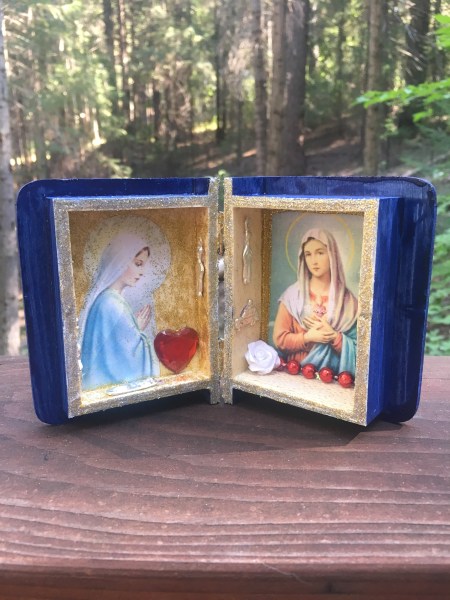
 me in a few directions. I had found myself drawn to meditate on the Goddess: Gaia, Brigid, Diana/Artemis, among others – this surfaced years ago. This year, I have returned to bring home an aspect of my Roman Catholic roots. That is turning my attention back to the Blessed Mother, Mother Mary, the Madonna. In addition to meditation and contemplation, I have opened myself to a kind of creativity that blends these ingredients by crafting small shrines in Her honor. As a longtime artist and craftsperson, I see how my consciousness shifts when I get into ‘the art zone.’ Time freezes, senses come alive, thoughts cease, and something bigger opens. This is just my current way of doing things and experiencing the mysteries of the process. I am no expert when it comes to the Divine Feminine. Like everyone else, I search for meaning.
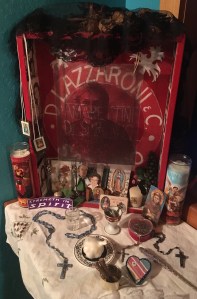 much from his time with Iroquois, Moss writes that tending to dreams was the first order of the day for the community. Whether grief is resolved or unresolved, visitation dreams, like all big dreams, require action. We can honor our dreams and those that visit us in many ways.
 shrine or altar, it is necessary to keep the space clean and to replace foods, water, and flowers daily-to-weekly. By honoring deceased loved ones in this way, it is like we are making the statement that the relationship is important no matter on what side of the veil we exist, and that we appreciate such dream visits. Furthermore, such action and attention may prompt additional, similar dreams.
 typing this, shifting through recollections.
 Conscious Chimera