does your pet talk to you?

This past month has brought many new experiences – isolation, restricted movement, heavier reliance on technology, and more. Almost all of the information flying towards us at warp speed, in addition to the COVID death toll, is about how we must take care of ourselves. Expert after expert is giving us instruction. As a psychologist, I think about this stuff a lot, but sometimes I just need to go somewhere different, take a new route, if you will.

So, with that said, let’s have some fun here. When we think of the concept consciousness, it’s typically human consciousness. How often do you ponder animal consciousness? Furthermore, how often do you think deeply about how humans can tap into the consciousness of animals? This article is about just that. Here, I will introduce you to Leslie Rolleri, an experienced pet communicator, who helps cat and dog owners understand their pet’s most intimate desires and needs. But first, let’s look into what pet communication is all about.

Pet, or animal, communication is the phenomenon whereby a human comes to know an animals thoughts and feelings as well as their energy and sometimes confusing behavior. Have you ever felt that your pet is trying to telling you something, but you just couldn’t figure it out? Most animal owners have had this experience more than once, and it can be frustrating.

Many animal communicators are also energy workers, psychic mediums, or animal behaviorists, and empathic. I know, that’s a wide spectrum, but it’s what I have found in my research and in speaking with pet communicators. These phenomena are all related.

My last dog, Sage, was an American Rottweiler. Sage met Leslie on a couple of occasions and liked her very much. Sage behaved differently when Leslie was around, especially when Leslie turned her attention toward Sage. It wasn’t strange behavior, per se, just different, and in a subtle way. I spoke with Leslie about her experience as a hired pet communicator. She explained how she works with an animal:

“I have had a strong connection to animals my entire life and found I have the ability to understand them and connect on a deeper level.  I’ve noticed all my life that pets would gravitate towards me and trust me. I studied an energy release work for pets under a pet chiropractor, which uses unconditional love to release physical tension helping pets to IMG_0521be more in the present.  I’ve also studied Theta Healing, a modality that uses the theta brain wave for intuitive healing. This modality works with animals to communicate in pictures. Yes, animals communicate in pictures and many understand words but they respond to energy and pictures immediately. Pets are simple, really. Most desire the walk you promised or a toy, or even a blanket they like to sleep on. Just like people they have personalities and motivations and dislikes. I have found that people also need to be worked on in order to help the animal’s situation and, when possible, I like to work with the whole family. I have a deep respect for animals and all life and feel a need to convey their wishes and desires. Often people want a dog or cat to behave a certain way and get upset when they don’t.  It’s all about reading their body language because they are always reading yours.”

Leslie continues, “When I first work with a client and their pet, I inform them that I will be checking in on their pet 15 or so minutes before the session to check in and see what the pet wants to show me and communicate.  I do this because once I’m there the client may distract my clear communication with the animal. It also gives me a chance to see if my intuition is correct, as I’ve never met the animal before. Usually this involves knowing their address and name and getting permission from the owner to work with their animal. When I’m working I’m sending unconditional love. Dogs are very loyal so they need permission from their owners to convey this is okay and a gift.  Before I leave to see a client I go into a Theta state at home and command I connect to an animal and once I’ve remotely located the pet I will first come into their space and ask for their spirit name and if It is okay to work with them. Then I will ask them intuitively to show me what is going on and what they would like to communicate to their owners and I will also do a body scan if there are physical problems. This takes just a few minuets and usually what I get are quick images of things and sometimes words like walk. Yes, most dogs just want a walk! Sometimes I will see a toy, say a grey teddy bear and a leash, or maybe a window and a particular colored blanket. Just like people pets have connections to their toys and situations and will let me know what they are missing or what is important to them. For example, I will jot down some notes like grey toy, walk, and also any physical areas I notice are dark. I don’t put labels on the areas unless I’m told something (for example, “it’s a blockage”), but often I’m not told it’s cancer. I just see the blockage and then I command Creator/Source to remove it in the highest and best way.”

When asked whether she believes anyone can learn to do this work, Leslie said, “I have always been very intuitive but anyone can learn this skill – it just takes some practice.”

Leslie commented on an animals diet. Considering pet food choices, Leslie added, “Most dry pet foods are not good for pets. Canned can be better however, dehydrated and homemade with fresh ingredients are the best.  I recall my Grandfather making his dogs food in a big pot on the stove. Today’s dry dog food is a rather new thing for our pets to digest, historically speaking. Raw is also a great alternative as most animals are hunting their food and eating it fresh, uncooked.  We all should be eating foods that are 70% hydration so eating dry food is the hardest on your pet so make sure they have plenty of fresh water.”

Leslie continued, elaborating on her experience working with pets, especially how injury and illness come into play. She shared that, “Often our animals take on some of our problems – they think they’re helping us. Yes, they can physically take on your illness – they are trying to help you. I will usually have difficulty finding cats as they sometimes don’t want to do the work and instead they will want to stay in a comfort zone. Once I’m able to connect with them (sometimes physically, sometimes remotely if they are hiding), they will usually come out and just stare at me wide-eyed as they realize I’m working with them. I usually do the energy release to get them calm and centered then I will convey their owner’s desires and also tell their owners their issues. Sometimes they feel like an outsider, sometimes they miss a family member and other times they just want that blanket back on the bed so they will sleep there again. Usually the client notices a shift in the animal within a few hours and over the next few days. I usually get info on time frames regarding illness or injury. Often within the session I will convey to the client the information that I’ve received (i.e. the cyst will burst, or the animals will get along and finally sleep together, or return home). Sometimes it’s subtle, sometimes it’s more obvious.”

So what can pet owners do? Leslie suggests, “You can help your pet so much by hearing what I’ve told you and then using your ability to visualize and communicate with your pet.  I realize it takes some work but they are already seeing your thoughts and reading your body language – you just need to be aware of it more.  For example, you’re trying to get your dog to drop the ball but it just wants to play and make you chase it around instead of listening to you.  Instead of getting upset or yelling, remain calm and send an image of your dog dropping the ball in your hand, your dog will pick up on the image far quicker then any verbal command especially if you are angry or making different deep or high pitched sounds. Also, if you notice your pet doesn’t like something. l always respect their boundaries. When you think about it this is what we would all like our experience to be so respecting your pets boundaries does wonders for you also in finding your own boundaries.”

When asked about her business location and services, Leslie stated, “I live and work in Sonoma County, California, but I can also do this work remotely, over the phone. If this interests you, be sure you are home when we plan a session. I prefer this because I have had check-ins where the client isn’t home yet and when I’ve connected they are traveling in a car, which can be disorienting for the pet.  When you are moving like this, time and space are influences making it more difficult. If you’re interested in learning more, Theta Healing books and classes are amazing. I encourage you to explore and try visualization with your pets and see how your connections deepen.”

Leslie Rolleri can be reached at


Light & love,

Kim
coping holistically though COVID-19

Here we are, living day by day with ‘shelter-in-place.’ The news reminds us to play it safe by wearing masks and gloves, keep the six foot minimum distance when in public, and most of all to stay home. In addition, media sources show us what to fear most and blast the death toll constantly. This provides information, sure – yet it can also increase stress and elevate fear, obviously. During these times, it is crucial that we learn to take really good care of ourselves, from the physical and mental, to the emotional and spiritual. This doesn’t need to cost a penny, nor does it need to become a burden. You can find a free 12 minute guided imagery experience at the top of my product page – or just click here.

I’d like to see more about holistic self-care from the media during times like these. I think the increase in online ‘happy hours’ and classes of all sorts has been really helpful as a way to build comradery, decrease lonliness, keep life as consistent as possible, and offer an alternative to television. There are some really creative outlets out there! For example, just about any form of physical exercise can do wonders for our mental and emotional states while ‘doing right’ for the body. Most people know this. Personally, I’m not a fan of the gym; I prefer exercises I can do in or near my home. Some of my favorites include mindful stretching and yoga, hiking, and dancing. Learning certain practices, even something totally new, can be done online. Tai Chi, Qi Gong, or yoga are just a few examples that bring with them a positive holistic impact. Mindful movement that attends to the breath does wonders! Most recently, I was invited to an online Zumba class and a group of friends decided to attend on the same day. Now that’s an energy release combined with laughter and emotional support!

Considering mental and emotional states, I think about my habit of overscheduling. I’ve been considered a “go-go-go” kind of person most of my life. It took a serious illness for me to learn to say “No” and seriously scale back. Furthermore, from my years teaching Cognitive Psychology, I knew that multi-tasking was not any faster than completing one task at a time. In fact, with multi-tasking we are worse off. Most people are doing too much. I knew I was too, but also struggled with making lasting change in this area. I’m hopeful that this virus will pass sooner than later, but until it does pass, we can use this time to ask ourselves how would we want to spend our time (especially if we knew we had so little of it left). So, if you need to say “No, thanks, not today” in response to an online invite of any kind, that is okay!

On a spiritual level, “living every day” becomes a way of life, especially for those most closely impacted by COVID-19. I’m talking about those that are currently ill or know someone who has been infected, along with every single person that is working to get us all through this: Nurses, mental health professionals, grocery store clerks, bankers, gas station attendants, and other service workers come to my mind immediately. How about for you? Those that cannot #StayHome during this crisis, may not be feeling isolated, but may be feeling incredible levels of stress. They may just want to sleep during the off hours and that is alright – sleep is very healthy. While on duty, conscious, abdominal breathing or slipping in a three minute mindfulness break while in the bathroom (I’m very serious about that) may be all that is possible. Do not underestimate the value of just these alone! If you are on the front lines, know that I am here for you and will gladly send free, pre-recorded guided mediations your way – just send me your email address through my services page. In addition, limiting exposure to politics and news stations can help reduce anxiety and relieve mental tension. You probably hear more than enough at work! Recognize what sources provide quality information as opposed to hype and drama.

Here are some additional ideas that can make life a little better when feeling alone, lonely or isolated, or in need of a little nurturing:

  • Get sucked into fantasy with a good book. Maybe reread one that you put back on the shelf years ago. I’ve been doing this lately and have even come across ones that I never read in the first place!
  • Begin journaling. Some prompts are as simple as “What am I feeling today? How is this similar or different than yesterday?” Other people use journals to write a letter to your future self. Project yourself in 5 years. What are your hopes and dreams for 2025? And of course there is dream journaling. Have you wanted to start engaging your dream life more? This just might be the time. Journaling our dreams is a great IMG_2508practice. Dreams are like a mirror, reflecting our inner world. They are the language of the soul. Dream plots and imagery are also inspirations for poetry, story-telling and art.
  • Take a sensuous bath – add oils, flowers, herbs or sea salts to the bath water. Allow yourself to soak away. Light candles or bring a good book for additional relaxation.
  • Write letters, the old-fashioned way, and snail-mail them. No text messaging this time! When was the last time you did this? I bet it’s been years. If you have old, used greeting cards, cutting them at the fold, turns the front side with design or picture, into a postcard. No need for stationary.
  • Spend time in nature. When was the last time you did a nature walk in your town? Get outside and notice what’s in bloom. Take in the spirit of mother nature, commune with her aliveness. If you have kids, a spontaneous treasure hunt or eye spy game is fun. Some kids love to collect leaves, bark and other tidbits to make a collage. Got glue?
  • If at all possible, allow yourself to sleep in! After all, you probably are not commuting to work or school (unless you work in particular industries, that is). That commute time, whether it be 30 minutes or an hour, can go toward increase shut-eye. This is healthy on so many levels and who knows, maybe you’ll have dream visitors – friends and family that, during these time, feel so far away. Give a dream hug! It can feel just as warm and beautiful…
  • Find a recipe you’ve always wanted to try and make it. Got any neglected cookbooks on your books shelf? This becomes extra fun with kids involved, so long as the adults feel calm and patient (Ha!). Or even better, go online and enter someone else’s kitchen – cook right along with them.
  • Consider doing a craft. This can really take our mind away from problems we are currently facing. Arts and crafts pull me into ‘the zone’ and I loose all track of time. How perfect on a rainy weekend! Consider this easy craft: Turn your attention to img_5155that stack of old magazines and catalogs lying around the house and simply rip out the images. Find glue or tape and a piece of cardboard, paper, or poster board (If you’ve ordered anything online recently, these can often be found in packing material once your product arrives) Once you’ve collected those, you are ready to begin constructing a vision board. The basics of vision board making include imagining what you want to complete or accomplish within the next 3-6 months. Be as specific and concrete as possible. From there, find images that reflect this. The idea is to create a board of images that move us in the direction we want to go. Imagery is powerful, so I suggest avoiding (or seriously limiting) the use of words or phrases – try to stick solely with images. I’ve made vision boards for my biggest goals: finishing a PhD program, getting published, finding the perfect home, and more.

Are you already engaged in any of these practices? Let me know what works best for you!


Wishing you wellness and inner peace,

Kim

My book, Extraordinary Dreams, can be purchased here!


divination in rough times

As we are all currently living through these uncertain times, the desire to know what lies ahead and what we can do for our future runs high. These days, with the heightened anxiety and strong waves of emotion and fear, it is diffcult to determine if we will out come out of this img_5062alright. What’s in your toolbox? We rely on our inner strength when separated from our communities. Mindfulness, prayer, and phone calls to loved ones help the days pass. I am certain that those who practice the art of divination are using all they know to navigate the oncoming terrain. If you have no experience in this area, why not start learning now?

Divination is “the art of discovering the future right now in the present,” it is the art of prophecy and the foretelling of the unknown, explains Judika Illes in her writings. The art of divination is passive in that it is not done to effect or cause change, but rather, it is a conscious attempt to obtain information regarding events. For many practitioners, she says, this art is sacred and spiritual.

This behavior, of divining, is nothing new. Divination has taken place for thousands of years, indeed it is an ancient practice that that grown and evolved over time. Long ago, diviners were consulted before the biggest decisions were made, such as those regarding war or sacrifice. There was great pressure to make accurate predictions, as you can imagine.

Just a few centuries ago in Britain, cunning folk (wise men/women) used methods of divination to restore or locate lost goods, whether stolen or misplaced. Sometimes divination was used to find a missing person. Other times it was used to make predictions, thus providing advice, on all sorts of matters. Wise men and women were also called upon to discover whether or not one’s illness or misfortune developed from malevolent witchcraft. As you can see from these examples alone, there are many reasons why one would want to develop this art, as it has served humanity for ages.

There many tools at the hand of a diviner – numerous methods and techniques are available for divination. Tarot, Runes, I-Ching and even palm reading rank at the top of the list concerning popularity. Below, I’ll describe some of my favorites or at least those that I find to be the most interesting.

  • Automatic Writing or Psychography is written communication with a spirit done unconsciously by a person in a trance or semi-conscious state, according to paranormal-encyclopedia.com, however, I tend to think of the writing that emerges as coming from ones consciousness or higher power. A piece of ‘automatic writing’ can bloom out of a simple guided imagery or even a light state of self-hypnosis. I’ve experienced this through different class/workshop leaders and have found that diverse facilitation styles work well.
  • Cartomancy is divining from cards. Sometimes the tool is a deck of tarot cards, img_5149other times it is a standard deck of playing cards. The branch of cartomancy that is specific to the use of the tarot for divination is called taromancy. I’m a fan of the classic Rider-Waite-Smith deck. I’ve had mine since I was 18 years old, tried-and-true!
  • Gyromancy is divination in which one walking in or around a circle falls from dizziness and prognosticates from the place of the fall. To expand on this definition, paranormal-encyclopedia.com, explains gyromancy as a form of divination that takes place by walking or twirling around a circle marked with letters until dizzy and, using the letters at the point where the person falls or stumbles to spell out a prophecy. Now that’s fascinating!
  • Necromancy is a form of divination that involves communicating with the deceased and can involve summoning of the spirits of the dead for purposes of magically revealing the future or influencing the course of events.
  • Oneiromancy is divination by means of dreams, specifically through the interpretation of dreams. This is a favorite. It is a divination method that I have practiced for about 15 years. One can incubate a dream in order to assist with the process.
    • Dreamers report receiving messages or learning new information from the dearly departed. I add this here because sometimes deceased loved ones pop up in dreams to express love or just to tell us that they are okay. This is different that necromancy, as defined above. You can read more on this in my book Extraordinary Dreams.
  • Radiesthesia describes divination through the use of a pendulum or rod. There are several ways in which to divine via radiesthesia. It describes the sensitiveness held to enable a person with the aid of divining rod or pendulum to detect things (such as the presence of underground water, the nature of an illness, or the guilt of a suspected person).
  • Scrying is sometimes called crystal gazing, but it is more accurately the term for divination by seeking a vision while gazing into a transparent, translucent, or reflective object. Crystal scrying, sometimes done with a crystal ball, is just one well known example. One can scry with a bowl of liquid (wine, water, ink), a mirror (or specifically a black mirror), in fire (including the embers or smoke) and even through another person’s eyes. My very first experience of scrying at the age of 19 was done through the eyes of another. This friend (and his eyes) were my first teacher into the art of scrying. Later, I came to prefer dark reflective surfaces because they have worked best in my experience. I take good care of my obsidian mirror.
  • Tasseography or tasseomancy is divination is done through the reading of tea leaves, coffee grounds, or wine sediments. Know that there are different ways to do this. For example, first brew a loose leaf tea (without a strainer), then when it has cooled down drink the tea as you concentrate on the question. Next, drain out the remaining bit of liquid by turning the cup over completely. Some or all of the remaining leaves will spill out. What remains in the tea cup reveals the prediction.

Throughout history, the ancient art of divination, in so many of its forms, has been both outlawed and condemned during certain periods of time, while during other times it has been praised by those in power, and even expected to some degree. Today, divination seems to have made its way into the spotlight again. Although those of certain persuasions do not speak highly of it. In my opinion, it is a personal decision to access materials and techniques for divination. If you don’t like it, leave it be. If instead, it calls to you, try it out. During this current ‘shelter-in-place’ order, it just might be the right time to delve into this ancient art. Just remember to dedicate yourself and practice daily. There are many experienced diviners of all types that are open to teach, consult and counsel. What tools and techniques do you want to learn more about? Which might you already use?

May your future be bright,

Kim

the body is always there

When you think about your life, what has been your guiding compass? Maybe it has changed over time, or evolved in some way. Our bodies can be this guiding compass, serving our highest good.

Our bodies are tools or vehicles providing us tangible or visual form to a feeling, a quality, or a state of being. How does this come about? Well, first know that the body is not the servant to the brain, as some believe. Through the practice of embodiment, and getting out of our head, we attend to sensations. From this calm, quiet space, we can gain new knowledge.

Let’s try a simple exercise: As you continue to read the next paragraph, maintain awareness of your posture. Be in your body fully, as you make any physical adjustments, scratch an itch, or shift your weight.

Yes, the body can produce new knowledge if we are patient and make room for it – areas of experience in which we were previously unaware can come forward. Embodiment is a non-verbal human trait. It is the present time felt experience of awareness in a moment as it is happening (Tantia, 2011). Embodied knowledge precedes cognitive awareness. Some have said that our autonomic nervous system is the system of the lived experience. By practicing the skills of embodiment, we may discover that some sensations do not have names or commonly used descriptive elements. That’s okay! One client I worked with earlier this week, used the term “Crinkly” to described his inner experience which was a combination of sensation with visual form located in a specific area of his body. Staying deeply in his body and experiencing what was manifesting in that moment provided him with information beyond what his thoughts, beliefs and judgments could offer. This bodily information system helped him make a decision about something he needed to do; The decision being an informed one from both his intelligence and his inner awareness.

Goldstein (1993) noted, “Practicing mindfulness of the body is one of the easiest ways to stay present in daily life…Our body is quite obvious as an object of attention, not subtle img_5092like thoughts and emotions. We can stay aware of the body easily, but only if we remember to do so” (p. 139). Are you still aware of your posture, in this moment?

With practice, we can experience embodiment while going about our day. If you are new to this, I invite you to put your electronic device down and close your eyes if that is comfortable for you. Take a few conscious abdominal breaths. Notice various sensations. Any areas of tension or numbness in the body? This is a beginning step which can expand embodied awareness with time dedicated to practicing.

Remember, the body is always there. Consider it a trusted guide, a lifelong friend, a forbearer of self-knowledge.

May we continue to blossom along with the coming spring season,

Kim

To order my book, CLICK HERE.

References:

Goldstein, J. (1993). Insight meditation: The practice of freedom. Boston, MA: Shambhala.

Tantia, J. F. (2011). Viva Las Vagus!: The innervation of embodied clinical intuition. The USA Body Psychotherapy Journal, 10(1), 29-37.

mindfulness

Everything I have shared here over the past four years, through the Conscious Chimera blog, has had an impact on my life. Every anniversary article, like the one I am writing this month, is extra special because they highlight subjects that are not only impactful, but have a special status in my life. Lucid sleep was the topic of Conscious Chimera’s 3rd anniversary article, and this month, for our 4th anniversary article, I will focus on mindfulness – it’s been over a year since I wrote on this subject. Mindfulness is a term that some have come to dislike. Is it because it is unclear, in vogue, an umbrella term, or something else? I don’t know, yet in this article I will provide some credible definitions and explanations to start. Mindfulness is so important because without an aware, mindful state, maintaining lucidity in dreams can be nearly impossible. Mindfulness practices support conscious dreaming and a conscious waking life.

So what is mindfulness? Mindfulness may be considered both a trait and a state of being, as well as a skill, and it may also be considered a practice or style of meditation. Through the cultivation of such a state, mindfulness expert Joseph Goldstein (1993) explains that mindfulness “uncovers the characteristic nature of experience itself.” But let’s not jump too far ahead. Becoming more mindful can be simple.

There are numerous ways to enter this “wakeful” state: anything that brings attention into the here-and-now by way of body, breath, and sensation, Goldstein (2013) explains. Consider these additional explanations by others in the field:

Mindfulness is bringing “neutral attention and non-judgmental awareness to body, breath, and sensations as well as anything passing through the field of awareness” (Desai, 2017, p. 230). Jon Kabat-Zinn, in a 2012 interview, stated, “Mindfulness is about love and loving life.” How perfect for this time of year – I’m a big fan of Valentine’s Day. Rick Hansen explains mindfulness in simple terms. He says, mindfulness means “being able to stay in the present moment, moment after moment after moment.” Sounds easy, but even simple tasks like this can be challenging. After all, most human minds are used to doing what they want to do, whether that be fixating on an issue from the past or imagining what can be cooked for dinner later that day.

Even with the simplest and most clear definitions, mindfulness is a huge topic, to include a variety of diverse practices, with no single agreed upon meaning (Davidson & Kaszniak, 2015). Disciplines such as yoga, tai chi, or qi gong cultivate mindfulness. Anyone can benefit from these.

As a psychologist who serves a lot of parents in my psychotherapy practice, I often get asked if mindfulness can be taught to children, and how to go about that. Yes, we can definitely teach mindfulness to children. According to Goldstein (2013), second graders have said, “Mindfulness really gets me calm,” and “Mindfulness helps me get better grades.” Isn’t that what every parent wants to hear? Other children have said “Mindfulness helps me calm down when I get upset. It also helps me with sports and to go to sleep at night.” Further more, second graders have stated, “Mindfulness is the best thing I have done in my life,” and “I love mindfulness.”

Both adults and elementary school aged children can begin their mindfulness journey in the simplest of ways. For example, attending to sensation while washing your hands is img_4983one way. What does the soap feel like on the skin? And the sensation of the water running over the skin? Is the water hot, warm, cool, or cold? Another way of practicing mindfulness is to ring a chime or bell, then stay completely focused on the sound until it is no longer detectable. After, notice all other sounds in the environment. A third example could be to smell some things in your environment and really stay with the scent. If your lunch is in front of you, that makes this easy. If not, look for flowers during a walk, or a bouquet at the office. From the two photos here, you probably have an idea of what I love to smell – haha! Seriously, if you are at all like me, you might even carry a sachet of dried flowers or an essential oil in your bag. This is one of the reasons why I make dream pillows (see my product page for an idea). A final example for this article would be to stay connected to your breath. Notice each inhalation and each exhalation. Are you img_4965taking long deep abdominal breaths, or are they shallow, in the chest? Just noticing and staying connected to the senses and the body are ways of entering a mindful state. I hope you are encouraged to bring mindfulness into your daily life.

Research on mindfulness reflects numerous benefits of a sustained mindfulness practice for both body and mind. If you live in Northern California, consider attending my upcoming March presentation: The Art of Presence 101

Interested in knowing more about mindful-based practice? Write to me at kmascarophd@gmail.com

May you be mindfully aware in your daily tasks and your wildest dreams,

Kim

To order my book, click here!

self-care

Happy new year to you all! This month’s article is not about resolutions, but about something we should be doing regularly (and probably should have been doing all along): that is self-care of the mind, body, emotions and spirit. It’s never too late to start – anytime is a good time. How about now?

Sure, it’s nice to take a steamy bubble bath, or buy something nice for ourself when we can afford it, even indulge in a sweet treat, or get a mani-pedi…you name it. However, caring for the self goes much deeper. I was exposed to this concept around 1999 or 2000 after having worked in the child abuse prevention and trauma field for a brief period of time. For the last 20 years, I have had a self-care regimen of some kind. Still, I have been treated for vicarious traumatization (VT) and secondary traumatic stress (STS)/compassion fatigue (CF) due to all the exposures in my field and my particular work as a trauma therapist over the years, in addition to my own history. Life can be complicated and we can be complicated creatures. No one self-care routine is best. They can differ drastically from individual to individual. One routine may feel sufficient for months, then suddenly more support may be needed in one or more areas. A lot of what professionals teach regarding self-care, we can learn on our own with some research and thoughtful consideration. If you are experiences symptoms of VT, STS/CF, consult with a professional – that is a licensed psychologist or licensed psychotherapist specializing in trauma. After all, it is an opportunity to have another offer evaluation, new ideas and emotional support through a heightened self-care process.

Sometimes, self-care is divided up into physical, mental, emotional, spiritual categories, which is alright, but I prefer to look at things differently because one action, or domain, can support each of these categories.

One major self-care domain is Time in Nature. Getting regular time in the great outdoors and away from busy city life can do wonders for our nervous system and for calming theIMG-4846 mind and the emotions. Taking in fresh air while surrounded by plants and trees is a gift in itself. We can connect spiritually in nature as well. After all, everything is alive. Some people I know go camping (sleeping on the ground directly) every season while others dedicate a weekend day to beach walks, forest trail running or engaging in the practice known as Earthing. Earthing, sometimes also referred to as Grounding, is basically walking barefoot on dirt or grass (not on concrete) for example, like our ancestors did. The last time I did this, it was 45 degrees outside. My feet felt the chill of the ground, but I was bundled up everywhere else, so I was fine. The practice of Earthing is recommended in order to absorb some earth energy, as the planet is negatively charged. IMG-4842The build up of positively charged free radicals throughout the day can be tamed through Earthing due to it’s antioxidant effect. It’s an anti-inflammatory technique! Instead of coffee, try 15 minutes of Earthing in the afternoon as a caffeine substituting self-experiment for relieving grogginess. If getting your shoes off is impossible, do not give up – do it with bare hands instead.
Another major domain in my life is Organic Whole Food, Plant-based Eating. I used to complain (a lot) that organic purchases were too expensive, and that I didn’t have time to cook. Then I had a wake-up call teaching me that buying cheap food on the fly can lead to expensive medical treatments needed to correct a problem I encouraged through my behavior and choices. The inflammatory garbage I was putting in my mouth most days came with a cost. Basically, it’s pay now or pay later with a potentially bigger cost. This decade, it is even more critical since hundreds of new chemicals are being introduced into the environment each year. We know (for years now actually) that babies are born with toxins in their umbilical cord blood. Pregnant mothers’ blood carries many toxic chemicals too, of course. This develops by way of environmental exposures, one being the pesticides in processed and conventional foods. Thinking more about costs, some organic choices are very affordable, such as bulk beans, grains, and even certain fruits and vegetables are similarly priced to conventional. If it’s possible to grocery shop with a friend or family member with similar interests, the experience can be educational, curious, and maybe even fun. Eating as clean as possible offers benefits not just for physical health, but mental and emotional health as well. It’s true – consuming organic foods can be a support for optimal mental and emotional functioning.

An additional major domain is what I’ll label as Cleaning. Our entire being –mind, body, emotions, spirit – can benefit from regular cleaning. By cleaning, I mean committing to actions that invoke reflection, gratitude, clarity, protection, and especially release. Here are some examples:

Unstructured, reflective journaling,

Warm epsom and Celtic sea salt baths,

Writing gratitude lists (at least 10 things I am grateful for),

Mindfulness practices including meditation and guided imagery,

Energetic services such as Reiki or acupuncture,

Tracking dreams and looking for patterns and themes,

Adopting a short home-based energy medicine routine (see November 2019 article),

Getting lost in a craft such as knitting, painting, or coloring mandalas.

That’s only eight examples, but naturally, there are dozens and dozens of ways to clean. I clean daily-to-weekly. How about you?

Most of the ideas I have shared here can be combined in a variety of ways and many of them support more than just one aspect of ourselves. What you see here is by no means an exhaustive list, so add to it, and please share your ideas with me. Remember, a solid self-care routine can be done at-home and cost nothing, or if you have extra funds, hiring a service provider can be very nice.

Everyone wants their personal compass pointed in the direction of good health, happiness, meaning and connection. The power to make changes lies within each one of us. There is no rule saying that changes must be drastic or come all at once. Every small step we make in the right direction for our lives and the lives of our loved ones is well worth it in my book. May this new year bring all good things your way!


2020 blessings to you and yours,

Kim

#selfcare

To order my book, click here!

winter season festivities

Season’s greetings! There are many holidays and celebratory traditions during this time of year. While I honor them all, there are a few traditions that are given special attention in my life given cultural and personal factors: these are Winter Solstice, Yule, and Christmas.

Winter Solstice takes place on the 21st of December each year and is the day of the year with the shortest day or period of light and the longest night or period of darkness. The attention given to this time of year by way of rituals and celebrations is ancient. We celebrate the return of the sun and the days getting longer and longer (until Summer Solstice that is). Winter Solstice is celebrated all over the world, yet it is Stonehenge that attracts thousands of people on this day. While I enjoy the slowness and ‘hibernation’ that winter brings, I am a true summer lover. So, there is excitement about each day becoming a little longer and longer.

The first day of Yule is typically on December 21st as well. Much of what many today associate with Christmas actually emerged from the Germanic tradition of Yule. Bringing nature indoors is the thing to do – trees, logs, garlands, holly, wreaths, mistletoe – you get IMG-4808the idea. In addition, caroling, bells, and candles also come from the yuletide season. The two traditions, Yule and Christmas, have blended together in many ways, yet are distinct. This year, the twelve days of Yule are from December 22nd to January 2nd. However, most years the yuletide season runs from December 21st to January 1st. Anytime during this period can be spent decorating the home with wreaths and garlands, or decorating a Yule log to burn one evening.

Having been raised Catholic, Christmas eve and Christmas day (December 24th and 25th) have always been a focal point. From midnight mass to tree decorating and from gift-wrapping to candy-making, this time has contained multiple family rituals across my lifespan. Enjoying special foods and offering gifts to family and friends is a highlight!

These seem to have some things in common. That is the acknowledgement of natural cycles – from darkness to the birth of new light. May you and your loved ones know peace this winter season and fully enjoy your unique expressions and celebrations during this time of year.


Happy holidays to you all,

Kim

To order my book, click here!

the psychology of energy

We took a break for October, but now we are back. Hope you enjoy the November article! Additional news I’d like to share is that I am now taking online clients that reside in the state of California. I specialize in a variety of women’s issues. Contact me for more info – see the services page.

Energy. It’s a word we hear often, especially in certain circles. Sometimes a person will hear that word come out of someone else’s mouth and immediately dismiss the speaker. Energy is real, of course. Everyone must know that. Otherwise how would X-rays, EEGs  or MRIs work? All of life is, basically, is an electrical field. The human body’s invisible infrastructure is energy. And from it, we can gather information and even heal, if we understand how to work with it correctly. Our energy systems of the body exist in an ongoing interplay with our thoughts and moods, as well as our cells and organs. If this reality has you feeling vulnerable, instead, allow it empower you. For every person has the ability and the power to behave in ways that can enhance and boost one’s energetic systems for the better. Near the end of this article, I will tell you more about this.

Many psychologists and psychotherapists, including myself, are astonished at how the tools of energy therapy (energy medicine and energy psychology) have had profound positive impacts for patients in a relatively short time, when longer term mainstream psychotherapy has done little. Because of my martial arts background (having been first introduced to Tai Chi at age 18) I knew a little about energy and it’s potential for manipulation. We would ‘play’ with our own energy in class, passing it between our own two hands or the hands of our classmate when instructed to do so. I saw how energy could be used to ‘over power’ an opponent in the various martial arts I studied after my initial Tai Chi training. My instructors over the years were predominantly from Asia, so they had a deeper understanding of this. Energy systems were a given. I’m so grateful for what they shared with me. Then, a little over a decade ago I was introduced to an intriguing world of healing with energy. I came across books by Donna Eden, David Feinstein, Dawson Church, Bruce Lipton, and Richard Gerber, to name a few. I attended a two-day training with Donna Eden and David Feinstein and was blown away. I had entered a new world, one in which was even more fascinating than the somatic psychology training I experienced in doctorate school. Yes, from grad school, I was taught that the mind-body connection was real, and how it functioned in a basic sense, but the world of energy medicine took it much further. When it came time to learn the meridian points and channels, I really felt that I was in over my head. Reminding myself that I was in attendance to learn something new with an open mind, and not enroll in medical school, I pressed on.

Today, I have retuned to using EFT (Emotional Freedom Technique) and Donna Eden’s Five-Minute Daily Energy Routine regularly. I wish I had never let it slip away, but it is better to re-engage lost healing tools than to not use them at all. I still regularly consult the books by the authors I mentioned above too, as they have a welcome place on my bookshelf. And I have no doubt that what I think, how I perceive events, and how I feel each day has a direct and lasting impact on my body and my health. With that said, we can also hold a powerful intention for these practices and insert affirmations to support that intention along the way. See the September article for more on intention and affirmations.

Whether life turns ugly or remains beautiful, we have free tools at our fingertips (taking up just five to fifteen minutes a day) for optimizing our functioning and promoting healing. I urge you to look into this, and if you feel inspired to use this energy intervention for your own or someone else’s benefit, do let me know. Share what you discover!

Here are the steps of the Five-Minute Daily Energy Routine created by energy medicine pioneer, Donna Eden. It is made up of 7-8 movements or poses. They are:

  1. The Three Thumps
  2. The Cross Crawl
  3. The Wayne Cook Posture
  4. The Crown Pull
  5. Lymphatic Massage
  6. The Zip Up
  7. The Hook Up
  8. Some add Connecting Heaven and Earth to the routine as well.

Now instead of describing how to do each of these, I will provide two links – each shows Donna Eden doing a couple different variations of a Daily Energy Routine:

If you do not want to watch the videos, you may find this information in the following three books:

*Energy Medicine: Balancing Your Body’s Energies for Optimal Health, Joy, and Vitality by Donna Eden with David Feinstein, PhD

*The Genie in Your Genes: Epigenetic Medicine and the New Biology of Intention by Dawson Church, PhD

*The Promise of Energy Psychology: Revolutionary Tools for Dramatic Personal Change by David Feinstein, Donna Eden, and Gary Craig.

I wish you good health on all levels,

Kim

To order my book, click here!

intention + affirmation = empowerment

So I see that I got a little behind on blogging. I’ve been so focused on yoga nidra and the homework requirements between the courses/workshops that time flew right on by! I’m delighted to share with you that I recently completed the 100 hour (basic level) certification in IAM yoga nidra, recognized by Yoga Alliance (IAM stands for Integrative Amrit Method). Now I am back at home, ready to return to my writing. Earlier in 2019, I blogged about dream yoga, yoga nidra and related practices, so I won’t go into definitions here. Instead, I will write about a specific aspect: #intention and #affirmation.

Before we jump in, I’d like to make a distinction for clarification. Scholarly journals include studies revealing the effects of self-affirmations for a variety of behaviors. Within social psychology, self-affirmation theory looks at how people adapt to threats or information related to one’s self-concept. People are motivated to maintain integrity of the self. Sometimes the effect of self-affirmation is impressive, other times, neutral. Much of the research is focused on health outcomes like smoking cessation, appointment attendance, dietary and exercise regimens. Basically, when it comes to cognitions, or human thought processes, healthy self-talk and positive language use can’t hurt. It reaches into concepts of self-adequacy and self-integrity. On the flip side, we know that harmful, negative thoughts have an ugly impact on human development, adaptation, and success potential. I needed to mention self-affirmation theory (similar to cognitive dissonance theory) so that we know what we are NOT talking about. Instead, what we are talking about today, is something much more conscious. Something closer to a personal motto or mantra, if you will.

I’ve been thinking a lot about intentions and affirmations, and how these ideas extend beyond ego to touch on the transpersonal or spiritual. I’ve used intentions and affirmations with clients and with myself over the years in a variety of ways. They have supported my daily routines, meditations, and everyday attitudes. There is a difference between these two terms – intention and affirmation – but sometimes they are used interchangeably. Kamini Desai of the Amrit Yoga Insitute taught me that by consciously withdrawing attention from our tendencies, and instead placing attention/action in the direction we want to go, we thereby set intention. According to the American Psychological Association (APA) Dictionary of Psychology, an intention is any directedness in one’s thoughts or behaviors, whether or not this involves conscious decision-making. Simply put, an intention is a direction (without a specific endpoint). Intention is in opposition to reaction. It’s important that an intention resonates deeply, with all parts of us, so it can be a focal point for a long time. I often include Cognitive Behavioral Therapy (CBT) in my psychotherapy practice – in those cases, intention setting typically involves deliberate decision-making. I recall one client who struggled with follow-through all her life (this was ongoing) and feared that she would not graduate (a new, specific goal). We worked on practicing new behaviors over several sessions. Even img_4580though this memory is a few years old, I recall that the intention we used was something like ‘I persist and complete tasks with ease.’ Like the photo here, we have to climb our way out of things and it can feel tiring with life’s hurdles, but our perception matters. We can sprinkle our climb with rose petals (gentle intention supported with loving affirmation). When cultivating an appropriate intention for hypnotherapy or a meditation practice such as yoga nidra, I often rely more on intuition. This is because I am operating from a bit of a different space – after all with CBT, it’s more analytical. In both cases, for me, there is embodiment, mirroring, and attunement, yet CBT adds analysis of thought and behavior. When I relax and tap in to the heart center, and get out of my head, I have found that a trusted intention naturally emerges for myself or for a client or group. Here are some examples that one of my yoga teachers, Dr. Desai, shared with me:

I am timeless presence.

I am a carrier of peace.

I rest in the power of divine presence.

I recognize the way the universe supports me.

I ask for what I need.

Trust that you’ll know it’s the right one when you sense its resonance, perhaps through a subtle shift in the body. Keep it short and concise if possible. Ask yourself, Does this intention help me grow, become better, relax into life? If yes, then you are on the right track. I still recall this one from when I was working toward hypnotherapy certification in 2005: I am open, intimate and connected with others. Anytime my thumb and forefinger touch (anchoring), that phrase immediately comes into my awareness. That has grown to become, I stand in wholeness for 2019. Both of these intentions have served me for many months, and in the first example, many years. They allow me to settle in to my body and engage the world as it is.

As stated, intention and affirmation are terms often used interchangeably, yet to be technical, the specific distinction is that affirmations support the intention. Mornings are a wonderful time to set an intention, and throughout the day, one to three affirmations can be repeated to support that intention. Alternatively, one can simply return to the original intention. Or one can bring in the affirmation throughout the day.

Affirmations I have used with others when facilitating yoga nidra, or in my own practice are,

I open my heart completely and surrender fully and embrace totally what is present.

My body is the light – my heart is unconditionally open.

I shift out of reactivity and accept what is.

I am the designer of my destiny.

I trust the wisdom of my body to heal itself.

Everyday, in every way, I get better and better. (This final example might make a nice intention as well).

As long as there is total resonance while using affirmative, positive language, you can’t really go wrong. Just remember that an intention is like an orientation on a compass, which is often long-term, whereas an affirmation supports that direction and can change daily.

Intentions and affirmations can be written down and read or said aloud, proclaiming it to the universe. I say that it’s best to do both! They are often inserted in a hypnotherapy or yoga nidra session. Intentions and affirmations for future use might even emerge naturally as I guide my clients to the surface of awareness near the end of a session. For this reason, I advise keeping a notepad and pen at arm’s length.

When I teach on how to construct a vision board, intentions and affirmations are at the forefront. Even though a vision board is usually crafted in support of a specific goal with img_4549an end date, one can also be created as a reminder to keep our internal compass pointed in a particular direction. Think empowerment! Daily affirmations can enhance and fuel the totality of the vision board experience. This visual tool is as powerful as intentions and affirmations themselves. To learn more, write me or attend my vision board class in Auburn, CA this December.
Happy Fall,

Kim

#empowerment

To order my book, click here!

for the love of cats

Did you know that today, August 17, 2019, is national Black Cat Appreciation Day? More on that in a moment. But first, I want to let you know that there is purpose and many good memories behind what I am writing here now:

This article is dedicated to an extraordinary being, Mia (2001-2019),

who taught me that cats are far more than their stereotypes.

Adventurous, wise, loyal, spirited – that’s what Mia immediately invokes within me.

She is missed.

There are several types of cats, big cats, small cats, and domesticated house cats. This article will focus on a few of them, and in particular, one I have dreamt with for years. Cougar, Mountain Lion, Puma, Panther – one mammal, many names! They are native to the Americas, therefore occupying a wide range of territories, from deserts to swamps to mountains. Furthermore, they literally have the largest range of any terrestrial mammal in the Western Hemisphere, aside from humans, of course. I live in a Northern California forest alongside this animal, although, I have been dreaming of these particular types of cats even when I previously resided in a highly populated city within the San Francisco Bay Area.

According to some animal facts provided by the San Diego Zoo, scientists classify these (Cougar, Mountain Lion, Puma, Panther) as small cats, because they purr like smaller cats do, rather than roar. These types of cans also squeak, yowl, hiss, mew, spit, and growl. Sounds like some house cats I have known! However, their slender body and calm demeanor are more like that of a cheetah; both cats would rather flee than fight, and both rarely confront humans.

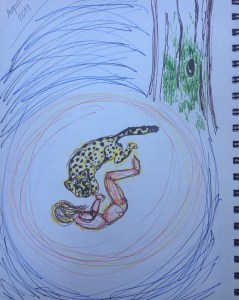
img_4449Two nights ago, and to my surprise, youthful Cheetah (a cat native to the other side of the planet) appeared in my dream. It is possible that the wild dream cat was a young mountain lion, as they also have spots when little. While not yet appearing to be fully grown, the facial patterning was remarkable. I gazed at his face and into his eyes. Near the end of the dream, we curled up together and went to sleep.

Within the big cat world, cheetahs are the sprinters, moving at incredible speeds. They can cover up to 22 feet in just one stride, thanks to their incredible flexible spines. Cheetahs are a nice mix of social and solitary. They are not as social as lions, but not as solitary as Pumas/Mountain Lions. One unique quality is that they do not have retractable claws like other big and small cats do. Unlike those cats, lions are quite social, living in prides, and are very good communicators – they talk to each other in many ways, one way is by their roar. A cub practices roaring early on, but it isn’t until it becomes about a year old that it can produce a serious roar.

Both big and small cats appear in the Tarot. Various tarot card decks depict these cats. I’ve seen a couple depictions of big cats within the major arcana in the Rider-Waite-Smith and Thoth decks. Major Arcana card VIII, Strength, in the RWS collection includes a lion. As for the Thoth deck, card XI, Lust, depicts what appears to be a chimera of sorts – a lion body with serpent tail. It’s a beast with seven heads. A nude woman lunges on the beast’s back. Also in the Thoth’s minor arcana, the Princess (aka Page) of Wands depicts a stunning fiery image. A woman pulls a tiger by the tale as she goes flying through flames, or so it appears. Wands are associated with action, doing, creative energy, and the element of fire. Now there is a Cat tarot deck featuring cute-looking housecats, but that’s a whole different story – ha! I do not own that deck. According to Peruvian shaman, don Oscar Miro-Quesada, if puma has come into your life, the sun or element of fire may also be powerful medicine to you. I do not know of a tarot deck that specifically includes our cat known by many names (that is, Cougar, Mountain Lion, Puma, Panther), aside from number 17 of the Medicine Card deck. Do you?

Cats are powerful and sleak, said to have excellent hunting prowness, insight and a keen awareness. In some metaphysical and spiritual circles, cats are also said to have an ability to see beyond ordinary perception – it’s their special power, their medicine. They have a long history associated with folk magic and women’s traditional ways. As the European Dark Age gave way to the roughly 700 year Inquisition period, cats were allegedly tortured and burned at the stake. Sometimes this practice took place alongside their owners who were accused of practicing those traditional ways. Often, these were poor country folk. Even though the inquisition faded away almost 200 years ago, there are still myths surrounding cats and women.

Cats of all types appear in people’s dreams offering comfort, console, reminders, and even instruction. In addition to my wild cat dreams, housecats often appear in the img_4441dreams of their owners. Bonnie and her cat Jessie still meet in dreams, even though Jessie died in 2012. Jessie was a tuxedo cat, meaning that the cat’s coat was mostly black with some white patterning on the front part of the body. Bonnie told me that Jessie often comes into her dreams. Mia has appeared in her mom’s (the owner’s) dreams throughout the years – even after she crossed over.

Even today, due to the myths, fears, and stereotypes, black cats are less likely to be adopted than cats of another color or patterning. So today, on Black Cat Appreciation Day, consider adopting a cat, black or not, in Mia’s honor. And seriously, go ahead…let a black cat cross your path!

Dream big,

Kim

To order my book, click here!