The term intuition is arising in many discussions lately regardless of how misunderstood it is. These brewing discussions conceptualizing intuition can sometimes seem messy, complex, intricate. One question I hear often revolves around how one can distinguish a reliable ‘intuitive hit’ from anxiety-provoked perception, sensation and chatter. This is important to consider given that so many people make big decisions based off of intuition By understanding what intuition is and how it works, we can come to rely on it. Here, in this article, I’ll share some definitions, science, and my thoughts on this hot topic.
I think of intuition as an evolutionary, life-promoting sixth sense also referred to, by some, as “a gut feeling.” This kind of insightful perception is immediate – it does not involve reasoning, critical thinking, or reflection. But how is intuition experienced? Intuition can arrive as a felt sense, an inner voice, or even as visual imagery. Furthermore, intuitive knowledge arises in a nonverbal flash without having links to a memory or emotional pattern.
The foundation of intuition is in the body. The body and intuition are very much connected. Neural correlates, particularly the tenth cranial nerve (aka vagus nerve), are involved. This extra special nerve travels far, running from the brain downward to organs and the gut. So, it is our organs, nerves, and brain that form a multi-way communication system. Remember, the brain is not the only one sending out messages. Knowing this, we can work with other locations in the body to further develop our intuition.
Key to truly understanding the complexities of intuitive process includes familiarity with the nervous system, therefore, I will include a little about it here. The autonomic nervous system (ANS) has three parts—the enteric, the sympathetic and the para-sympathetic. The enteric, sometimes called the intrinsic nervous system, is a complex system of 100 million nerves that regulate digestive activity. The enteric system transmits and processes messages in addition to other functions. The sympathetic nervous system is responsible for action, such as defending ourselves or running away from danger, so blood pressure increases, digestion slows down, and the heart beats faster, while the parasympathetic is like put- ting on the brakes—resting and digesting, for instance. Here, pulse rate decreases, blood pressure slows, and food can be digested. The ANS is always working so that our body’s internal functions behave normally.
Here is where our behavior and lifestyle come in to play. Many of us have lost our relationship to ourselves, especially our own bodies. Knowing that the parasympathetic nervous system and the vagus nerve are not isolated, overly busy lifestyles (always being on the go) lead to a nervous system that is activated (Over-activation of the sympathetic is tied to health problems, but that is for another article). From that activated place, it is impossible to remain fully embodied and tune in to our deeper ways of knowing. Thoughts are much faster than the rhythm of the body! One way to counteract this and regulate ourselves is through conscious breathing which slows the heart rate. Nature can help too! Pair that with exercises for grounding, which are done by attending to sensation. Through these processes we can think more clearly and increase embodiment, thus giving ourselves the opportunity to further develop our intuitive ability, because they slow us down. It’s just what we need to develop intuition that is clean and clear.

Side note: if the idea of embodiment is new for you, read this – Embodiment is both a state and a process. It is inhabiting the body and locating ourselves. At this very moment, notice what your body is experiencing—that’s embodiment.
Always remember, intuition is connected to the body. Do not confuse intuitive hits with information emerging from states of anxiety or old schemas and perceptions. With continued practice, we come into deeper relationship with the body, attuning to our inner awareness more and more. When we do the work, we can come to trust our intuition, I believe, given the right circumstances.
I’ll close with the words of friend and colleague, New York based Somatic Psychologist, Dr. Jennifer Frank Tantia: Considering the body as “a gateway between consciousness and unconsciousness, and when those two parts from our thoughts to our emotions to our embodied experience can speak to each other, we can start to find a more holistic way of living in ourselves.”
May 2022 bring fulfillment and growth,
Dr. Kim
PS. Two things: In my new book, Dream Medicine, you’ll find an entire chapter on intuitive development. So, if this topic is important to you and you can carve out some reading time this season – a luxury these days – order the book here: https://mcfarlandbooks.com/product/dream-medicine/
I teach skills for developing intuition in my California private practice. If you are a CA resident and would like to work with me one-on-one, just click on that tab found within this website.
#intuition


 deeper, something critical for long-term survival and prosperity. This lack is rooted in the spiritual (not to be confused with religious dogma). We have collectively lost our divine feminine soul.
 collaboration. Those qualities enliven feminine energy and when they are lived through the body and move the spirit, we touch the divine feminine.
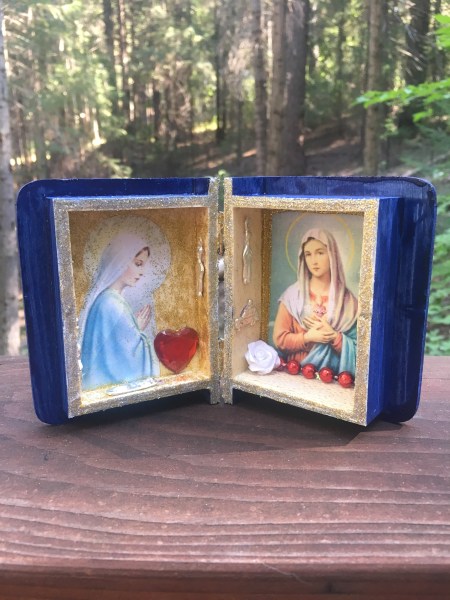
 me in a few directions. I had found myself drawn to meditate on the Goddess: Gaia, Brigid, Diana/Artemis, among others – this surfaced years ago. This year, I have returned to bring home an aspect of my Roman Catholic roots. That is turning my attention back to the Blessed Mother, Mother Mary, the Madonna. In addition to meditation and contemplation, I have opened myself to a kind of creativity that blends these ingredients by crafting small shrines in Her honor. As a longtime artist and craftsperson, I see how my consciousness shifts when I get into ‘the art zone.’ Time freezes, senses come alive, thoughts cease, and something bigger opens. This is just my current way of doing things and experiencing the mysteries of the process. I am no expert when it comes to the Divine Feminine. Like everyone else, I search for meaning.

 those properly educated on their use, thus aware of the benefits and possible drawbacks. When it comes to essential oils, use caution and consult with a professional before diving in. My biggest concern is that many people are ingesting synthetic essential oils, whereby making them anything but essential! Essential oils are for external use only and should be diluted with a carrier oil (such as jojoba, for example) or lotion. Before using essential oils, consult your healthcare provider, especially if you are pregnant, nursing, taking medications, or have any health conditions.
 practice. Dreams are like a mirror, reflecting our inner world. They are the language of the soul. Dream plots and imagery are also inspirations for poetry, story-telling and art.
 that stack of old magazines and catalogs lying around the house and simply rip out the images. Find glue or tape and a piece of cardboard, paper, or poster board (If you’ve ordered anything online recently, these can often be found in packing material once your product arrives) Once you’ve collected those, you are ready to begin constructing a vision board. The basics of vision board making include imagining what you want to complete or accomplish within the next 3-6 months. Be as specific and concrete as possible. From there, find images that reflect this. The idea is to create a board of images that move us in the direction we want to go. Imagery is powerful, so I suggest avoiding (or seriously limiting) the use of words or phrases – try to stick solely with images. I’ve made vision boards for my biggest goals: finishing a PhD program, getting published, finding the perfect home, and more.
 Conscious Chimera